DEEP DIVE
Sipping From the Firehose of Longevity News
By Esther Landhuis
A veteran science journalist explains why lifespan research is often sensationalized and misunderstood.
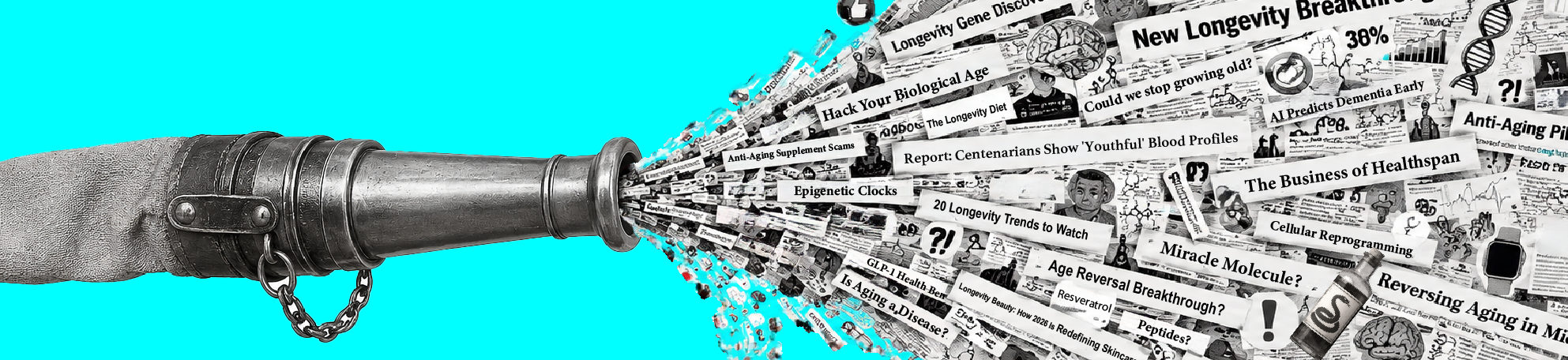 “Genes May Control Your Longevity, However Healthily You Live,” blared The New York Times. “The Secret to Long Life? It Could Be in the Genes After All, Say Scientists,” announced The Guardian. Both outlets were covering new research from the journal Science, which found that more than half of a person’s lifespan comes down to their genes — more than double the genetic contribution scientists had previously attributed to a long life.
As a veteran science and health journalist with a PhD in immunology, my attention was piqued by these headlines. Does a healthy lifestyle — good sleep, nutrition, exercise and strong relationships — really determine less than half of our lifespan, I wondered? Yet again, I saw this study was getting picked up by media outlets and social media influencers. And if I, with years of experience conducting and decoding scientific research, was perplexed by this latest longevity news, how could the average person be expected to make sense of it?
Non-scientists tend to learn about results, not process. Results are the lines on a graph, the final sentences of the abstract, the bite-sized nuggets in news headlines. That makes science appear as a series of logical steps connecting question A and answer B. But appearances can be deceiving. New findings don’t necessarily change what we know; rather, they add to what we need to understand.
Enjoying SCL Magazine?
Stay informed about the ideas, research, and people shaping longer lives.
Talk to any scientist and they’ll tell you that research is a journey into the unknown, fraught with twists, turns, failures and disappointments. A researcher can spend years in that cloud of confusion — repeating an experiment again and again, troubleshooting methods, trying new reagents, reconsidering assumptions, pushing, pivoting, wondering. Eventually, with perseverance and well-timed luck, they will emerge at point C.
Whereas results are bullet points and short lines, process is the convoluted, spaghetti-like path to a fresh insight. “Once you see it, it becomes obvious,” says Uri Alon, a systems biologist at the Weizmann Institute of Science in Israel and senior author of the attention-grabbing heritability study, who demystified the true, messier nature of science in a TED talk.
What’s also not seen by the general public is how a scientific study becomes a news story. Here’s how it works: The most newsworthy studies in the most prestigious journals get an embargoed press release — a research summary that journalists see in advance under the strict condition that they do not publish or broadcast their story until a specified date and time. The embargo allows reporters to prepare their pieces for release coinciding with the study’s publication in the scientific or medical journal.
But the embargo system creates constraints. Since top media outlets aim for same-day publication, reporters must read the paper, identify and interview independent experts, and draft and revise their article within a short period — often a week or less — which can lead to errors, information gaps and sensational headlines that generate high readership, the bread and butter of online media organizations.
KEEP READING
FIVE QUESTIONS
Laura Carstensen on Longevity’s Big Moment
ALT/SHIFT
La jubilación? Choju? Ruhestand?
DEEP DIVE
Sipping from the Firehose of Longevity News
GRANDPEOPLE
Fossil Fascination Sparks New Career
GAME CHANGER
Rachel Zoffness on Treating Chronic Pain
FINANCING LONGER LIVES
The Long-Term Care Wake-Up Call
@SCL:
Healthy Aging 2026: Purpose, Power and Play
Xue Yan Ho: Worms, Aging and the Quest to Prevent Neurodegeneration
Antoine (Po-Han) Ho: Skin as a Window to the Body’s Health