
FROM THE EDITOR
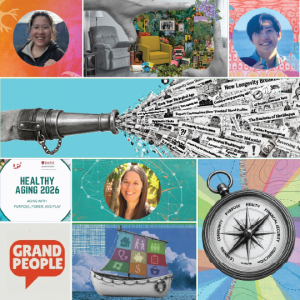
Over nearly 20 years of leading the Stanford Center on Longevity, founding director Laura Carstensen has done a lot of explaining. When I asked Laura how she described the Center’s work in its earliest days, she replied, “People thought we were following in the steps of the Methuselah Foundation.” Rather than an organization dedicated to life extension, SCL under Carstensen’s leadership became something else entirely — a globally recognized center for applied, interdisciplinary research into how societies can adapt to longevity, improving the quality of life at all ages, so that more people can remain healthy, socially engaged and economically secure as they grow older. As she steps away from her role as director for a well-earned sabbatical and to develop a new online course on fundamentals of longevity before returning to teach in 2027, Carstensen shares her reflections in Five Questions.
A cornerstone of Carstensen’s legacy is the New Map of Life initiative, a blueprint for redesigning the human life course for 100-year lives, as well as the social norms and economic institutions that shape us. Central to the project is changing the narrative around aging — how to make longer lives better, starting in childhood, and designing programs and policies so that the benefits of longevity are available to all, not just the affluent.
Changing the narrative is harder than it sounds, especially at a time when the “wellness industrial complex,” immortality-seeking tech bros and legions of influencers do so much of the talking. Esther Landhuis, the rare science journalist who also holds a PhD in immunology, reports in our Deep Dive how readers can navigate this confusing media landscape to distinguish genuine scientific findings from misleading noise. Media literacy is an important piece of the longevity toolkit.
As Laura Carstensen noted in our interview she often hears that “aging still sucks,” largely because it is associated with pain and the loss of mobility. In our Game Changer, Laura M. Holson profiles pain psychologist Rachel Zoffness, author of Tell Me Where it Hurts, who advocates for a holistic model for treating chronic pain that highlights the role of the brain.
Another aspect of the New Map of Life is systemic change. In Financing Longer Lives, MP Dunleavey issues a wake-up call for policymakers and consumers about the critical importance of long-term care insurance and reports on the first publicly funded program in the U.S., an experiment in Washington that could become a model for other states.
We love words at SCL Magazine, and a provocative text exchange with my colleague Tamara Straus was the germ for what became a linguistic safari into the word retirement in Alt/Shift. Tamara unpacks how different languages and cultures describe a stage of life whose meaning has evolved beyond what any single word can adequately express. Whether it’s la jubilación, choju or Ruhestand, Tamara reveals the cultural codes about identity, purpose, obligation and what a life well-lived looks like.
Our work would not exist without Laura Carstensen’s vision and support. I can think of no better tribute to her tenure than a magazine full of exactly the kind of thinking she has always championed.
Wishing you a jubilant summer!
—Karen Breslau
Enjoying SCL Magazine?
KEEP READING
FIVE QUESTIONS
Laura Carstensen on Longevity’s Big Moment
ALT/SHIFT
La jubilación? Choju? Ruhestand?
DEEP DIVE
Sipping from the Firehose of Longevity News
GRANDPEOPLE
Fossil Fascination Sparks New Career
GAME CHANGER
Rachel Zoffness on Treating Chronic Pain
FINANCING LONGER LIVES
The Long-Term Care Wake-Up Call
@SCL:
Healthy Aging 2026: Purpose, Power and Play
Xue Yan Ho: Worms, Aging and the Quest to Prevent Neurodegeneration
Antoine (Po-Han) Ho: Skin as a Window to the Body’s Health