ALT SHIFT
How Much Health Data is Too Much?
By Laura M. Holson
For some users, the proliferation of continuous glucose monitors and other health devices can boost anxiety over wellness.
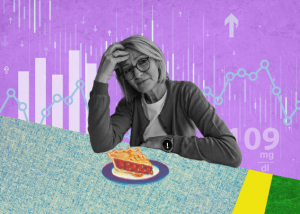 Last November, I made a questionable life choice: I ate a cupful of sweet-and-spicy rice crackers before crawling into bed. A week earlier, a colleague had encouraged me to wear a continuous glucose monitor to track my blood sugar and, for the week prior, it had fluctuated within a healthy range.
But that night, with the combination of rice, sugar and soy swirling in my stomach, my blood sugar shot up as if I’d polished off a box of Twinkies. I panicked as I watched the numbers soar and, because it was after midnight, sought advice from the only source available: the internet. One website told me to drink water. Another said to take a walk. A third warned that I might have to go to the hospital. By the time my blood sugar peaked, I had worked myself into such a tizzy, I couldn’t sleep. I checked it every 15 minutes until it returned to normal and, for the rest of the week, closely examined my glucose, steering clear of any food with rice or sugar.
Wearable devices are revolutionizing how we monitor and manage our health, with the market for all devices expected to grow worldwide to more than 650 million units by 2029.
The experience piqued my curiosity. If I had all this information to live a healthier life at my fingertips, why did I feel more anxious than informed?
Wearable devices are revolutionizing how we monitor and manage our health, with the market for all devices expected to grow worldwide to more than 650 million units by 2029, according to IDC Corporate, a technology research firm. For people with significant health conditions, wearables — heart monitors, sleep trackers and continuous glucose monitors — are a boon because they allow doctors to manage patients in real time. But for consumers who experiment without medical guidance, as I did, or worse, take their cues from social media, the smallest shift can trigger anxiety or obsessive behavior.
The devices are also fueling a culture of constant self-observation, prompting people to document personal metrics with the gusto of a Wall Street trader tracking a volatile stock market. Social media is rife with health-conscious celebrities and twentysomethings who flaunt their devices. (Last year, Gwyneth Paltrow was spotted wearing a glucose monitor while making pancakes.) The frenzy over glucose has even sparked a new subset of online influencers like the Glucose Goddess, as well as fitness models who market and sell diet plans and supplements to the glucose-curious.
Already, in some quarters, we are seeing a backlash. In 2024, Psychology Today likened the fixation with biometrics to a driver so focused on dashboard readings that they forget to watch the road. Users, too, are annoyed by the torrent of updates and analysis. “It was a joy to have a bowl of pasta without getting a scorecard,” said a writer in The Cut after she ditched her continuous glucose monitor. This begs the question: Are people living healthier lives with all of the information they are collecting?
Stanford genetics professor Michael Snyder, dubbed “medicine’s most measured man,” is an evangelist for the wired life. In a recent interview, he held up his arms to show multiple data monitors attached to each wrist that measured everything from heart rate to skin temperature to oxygen level. Snyder says people should begin documenting their heart rate, glucose and oxygen levels when they are healthy so they have a baseline. And with good reason. Snyder, who wears multiple health monitors daily, was on a flight to Norway in 2015 when he noticed his blood oxygen level drop significantly, while his heart rate climbed. When neither returned to normal after landing, and he began to feel sick, he surmised that he had contracted Lyme disease on a trip to rural Massachusetts. He was swiftly treated.
“The fact that you could track disease with these things was quite powerful,” Snyder says.
A recent study of 172 people with atrial fibrillation showed that wearing a device to monitor heart rate amplified anxiety, leading to more calls to health providers.
Studies show too that devices can impact behavior. A study of 2,217 people found that recording food intake and physical activity data on an app, while using a glucose monitor, led participants to make healthier lifestyle choices. Snyder, who was involved in the study, says wearable devices could help curb the high rate of diabetes and prediabetes among Americans if they create awareness. But, he cautions, “We need to be pulling in data in a systematic way that’s very meaningful.”
That’s proving a tricky balance to find.
A recent study of 172 people with atrial fibrillation showed that wearing a device to monitor heart rate amplified anxiety, leading to more calls to health providers. It was unknown whether patients actually needed to see a doctor, or if their anxiety contributed to their worsening symptoms.
Equally concerning is what companies plan to do with all of the data they are collecting. For now, it’s unclear. A 2025 study evaluated the privacy policies of 17 leading wearable technology makers using criteria like transparency, information sharing and security. Researchers found that data governance was inconsistent and recommended that rules be adopted to protect consumer privacy. “Insurers might use health data to risk-profile individuals,” the study warned, “potentially leading to higher premiums.”
Conflicting views of wearables are common among young and healthy users, which are a big market for these devices. Saika Sharma, 28, a product manager at Microsoft, likes her Oura Ring because it combines resting heart rate, sleep quality and activity level to deliver a “readiness score” that predicts how physically prepared she is to face the day. Still, she says she can’t help but wonder about the long-term impact of optimizing and storing so much data. She says she wears her Apple Watch less now that she has an Oura Ring. And some of her friends have taken to “microdosing” their devices, mostly to track exercise.
Some users even turn tracking into a game. When Sharma’s brother moved to California to attend college last year, the step count on his Apple Watch jumped dramatically due to the hilly campus. His friends in Atlanta, with whom Sharma says he shares data, saw his steps surge. So, they tried to outwalk him. “There’s a competitive component, for sure,” she says.
Robert Goldel, a neuroscientist and data-driven technologist who has studied military veterans’ use of wearable devices, says consumers are missing important context in the race to optimize their biology. Physicians are hard-pressed to sort through the fire hose of data gleaned from devices. “If we just throw the data at clinicians, they would be overwhelmed,” Goldel says. But left to their own devices, patients could misdiagnose themselves. That’s why doctors and patients should discuss wearables as part of a larger health program. “If it means more data, more information, but less meaning, then it’s ultimately leading to more noise rather than a sense of purpose,” Goldel says.
After the rice cracker incident, I spoke to my doctor, who suggested that some protein, a boiled egg or perhaps a couple of walnuts might be a smarter midnight snack. Or, better yet, don’t eat anything until breakfast. Faced with those choices, and the specter of another alarming blood sugar spike, I had to agree with her.
Laura Holson is an award-winning writer and founder of The Box Sessions. She worked at The New York Times for more than 25 years, receiving a National Magazine Award for public service reporting.
KEEP READING
FIVE QUESTIONS
Bruce Feiler on Mastering Life Transitions at Any Age
ALT/SHIFT
How Much Health Data is Too Much?
FINANCING LONGER LIVES
Retirement Income Gap Sparks Innovation
DEEP DIVE
Why More Companies Are Recognizing the Benefits of Keeping Older Employees
GRANDPEOPLE
Soufflé Chef Takes her Final Bow at 90
FROM THE EDITOR
LONGEVITY LITERACY
Multiomics
GAME CHANGER
An Ultrasound Helmet to Cleanse the Brain
@SCL:
SCL at World Economic Forum
Call for Case Study Submissions
Longevity Design Challenge Finals