GAME CHANGER
An Ultrasound Helmet to Cleanse the Brain
By Liz Wollman
A non-invasive method for removing waste from brain cells of mice shows potential for treating neurological diseases in humans.
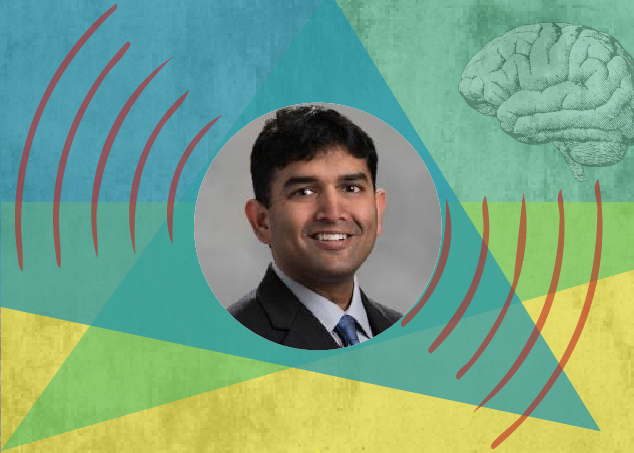 Stanford neuroradiologist Raag Airan’s breakthrough was aided by a harmless human error.
During an experiment into the blood-brain barrier, Airan meant to pulse an ultrasound into a mouse’s brain as a way of tracking drug delivery. But the machine wasn’t configured correctly. Rather than seeing dots of contrast in the image to illustrate the drug crossing the barrier, Airan saw smearing. That suggested the ultrasound was creating or accelerating movement resembling circulation in the cerebrospinal fluid
Since the movement of cerebrospinal fluid is the brain’s way to clear out waste, Airan and his team designed a study to see if ultrasound could be used to aid or direct that process. Last November, Airan’s team published their findings in Nature Biotechnology, documenting that ultrasound therapy was effective in clearing molecular waste and lowering inflammation in the brains of mice, possibly enhancing brain function and overall health.
Since the movement of cerebrospinal fluid is the brain’s way to clear out waste, Airan and his team designed a study to see if ultrasound could be used to aid or direct that process.
The next step is to see whether ultrasound therapy can deliver similar results in humans, whose brains have distinct neurobiological differences from mice. Airan and his team at Stanford Medicine have prototyped and are in the final stages of building a helmet that can deliver ultrasound to the human brain. Next, they are planning a human clinical trial to test the protocol, with the goal of healing brain injuries caused by strokes or other neurological traumas. The group is waiting to receive a Non-Significant Risk (NSR) designation for the innovation from a Federal Drug Administration Institutional Review Board, which would allow the trial to proceed without FDA approval.
Airan’s team is also aiming to study whether the technology can alter the effects of aging on the human brain. There is already some evidence from Airan’s previous study that the protocol clears certain markers of aging in mice. “We’re exploring extensions of our results to aging in mouse models and will be exploring effects on aging and neurodegeneration in our upcoming first-in-human trial of this protocol,” Airan says.
Airan’s interest in medicine, like his ultrasound discovery, was somewhat accidental. He studied physics and math as an undergraduate at MIT, and then got hooked on applying those fields to medicine. As an MD/PhD student at Stanford in 2004, he started working with Stanford neuroscientist and physician Karl Deisseroth in the emerging field of optogenetics, which uses light to control cellular behavior. “That showed me the power of that kind of interventional tool for studying the brain,” Airan says.
Central to Airan’s work is examining the glymphatic system, which flushes out waste from the brain and ramps up during sleep.
Specifically, he worked on using light to act like a drug — turning light on and off to trigger the same effects that certain drugs have in the brain. But there was a problem: Light can’t travel deep into the body. So Airan developed a new approach using sound waves to activate drugs at specific locations. “If you cover a flashlight with your hand, the light doesn’t get through,” Airan says. “Sound gets through.”
Central to Airan’s work is examining the glymphatic system, which flushes out waste from the brain and ramps up during sleep. The first half of the glymphatic system is the movement between cells of cerebral-spinal fluid. The second half is waste clearance. The glymphatic system is similar to the lymphatic system and named for its dependence on glial cells, which support neurons by providing nutrients, forming the blood-brain barrier and clearing waste and dead cells.
Some neurodegenerative decline and disease is attributable to decreased efficacy of the glymphatic, or waste-clearance, system, Airan says. For example, recovery from stroke can be complicated and compounded by the recovery of this system.
In the upcoming clinical trial, Airan and his team hope to establish the safety and tolerability of the ultrasound protocol, as well as the degree to which it can translate to human subjects, with positive effects for those with brain injuries or neurodegenerative disease.
“What I hope to see is some evidence that we are indeed achieving in humans this robust effect that we see in mice between the immunologic effects of this protocol as well as markers that we are correcting the buildup of this debris in the brain,” says Airan.
Liz Wollman is a veteran business editor who previously covered Silicon Valley and the tech industry at The Wall Street Journal.
KEEP READING
FIVE QUESTIONS
Bruce Feiler on Mastering Life Transitions at Any Age
ALT/SHIFT
How Much Health Data is Too Much?
FINANCING LONGER LIVES
Retirement Income Gap Sparks Innovation
DEEP DIVE
Why More Companies Are Recognizing the Benefits of Keeping Older Employees
GRANDPEOPLE
Soufflé Chef Takes her Final Bow at 90
FROM THE EDITOR
LONGEVITY LITERACY
Multiomics
GAME CHANGER
An Ultrasound Helmet to Cleanse the Brain
@SCL:
SCL at World Economic Forum
Call for Case Study Submissions
Longevity Design Challenge Finals
RELATED ARTICLES
An AI-Powered Stethoscope for the Brain

Rx Creativity for Health, Life (and Fun)