
LONGEVITY LITERACY
Multiomics
By Laura M. Holson
A holistic approach in biology is driving advances in personalized medicine and disease understanding by integrating data that individual studies miss.
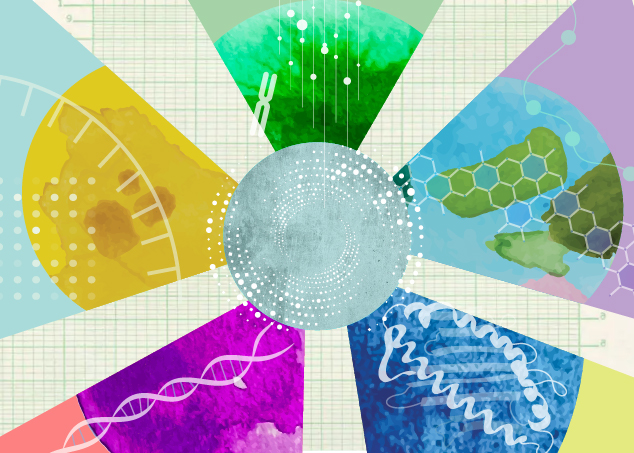 An emerging approach to human biology that combines information from genomics, proteomics, transcriptomics, epigenomics and other “omics,” a suffix used in biology and life sciences. Multiomics synthesizes data from these related disciplines, allowing scientists to get a more comprehensive, systems-level understanding of how the body functions and revealing insights that would be harder to detect if each “omic” was studied in isolation. As the field evolves, multiomics is helping scientists infer and test biological cause-and-effect more precisely, enabling physicians to fine-tune medications and treatments for an individual patient’s biology.
Combined with the rise of artificial intelligence, multiomics and genomics innovations have begun to create a paradigm shift in the understanding and practice of personalized, precision medicine. Advances in computing and data science are also making multiomics more practical and powerful. One obstacle, though, is organizing the large amount of data the study of multiomics produces. And there are challenges to implementing data-driven protocols into everyday clinical practice, including cost, bioethics concerns and regulatory issues. But as the approach improves, it could become easier and more affordable to use.
One of the biggest benefits of multiomics is that it can track changes over time. “We have got to get away from sick care to health care,” says Michael Snyder, a genetics professor at Stanford, adding that data-driven modeling over time allows for more in-depth analysis of individual drivers of health.
Variances in aging, for example, are not well understood. In 2020, researchers, among them Snyder, suggested that people may age along specific molecular pathways — immunity, metabolic, hepatic (liver dysregulation) and nephrotic (kidney dysregulation) — and could have distinct aging patterns, or “ageotypes.” Multiomics profiling could be used to reveal individual alterations in these molecular pathways, allowing medical professionals to monitor and intervene in the process of aging. Already, metabolic diseases such as diabetes are promising areas of multiomics research.
Beyond medicine, multiomics has the potential to transform the fields of nutrition and microbiome research, according to a 2025 research article about multiomics and dietary intervention. In particular, what people eat could be tailored to what their bodies specifically need versus broad-base recommendations. In short, multiomics brings multiple scientific perspectives together to reveal a deeper understanding of the human body and is reshaping how diseases are diagnosed, prevented and treated.
Laura Holson is an award-winning writer and founder of The Box Sessions. She worked at The New York Times for more than 25 years, receiving a National Magazine Award for public service reporting.
KEEP READING
FIVE QUESTIONS
Bruce Feiler on Mastering Life Transitions at Any Age
ALT/SHIFT
How Much Health Data is Too Much?
FINANCING LONGER LIVES
Retirement Income Gap Sparks Innovation
DEEP DIVE
Why More Companies Are Recognizing the Benefits of Keeping Older Employees
GRANDPEOPLE
Soufflé Chef Takes her Final Bow at 90
FROM THE EDITOR
LONGEVITY LITERACY
Multiomics
GAME CHANGER
An Ultrasound Helmet to Cleanse the Brain
@SCL:
SCL at World Economic Forum
Call for Case Study Submissions
Longevity Design Challenge Finals
RELATED ARTICLES
Cumulative Social Advantage

Beyond DNA: How Your ‘Exposome’ Shapes Your Health
Your genes are only part of the story. The exposome—the sum of all the environmental, socioeconomic and cultural factors you’re exposed to—shapes your health in powerful, often invisible ways.
Read more