DEEP DIVE
Our Households Changed. Our Neighborhoods Didn’t.
By Karen Breslau
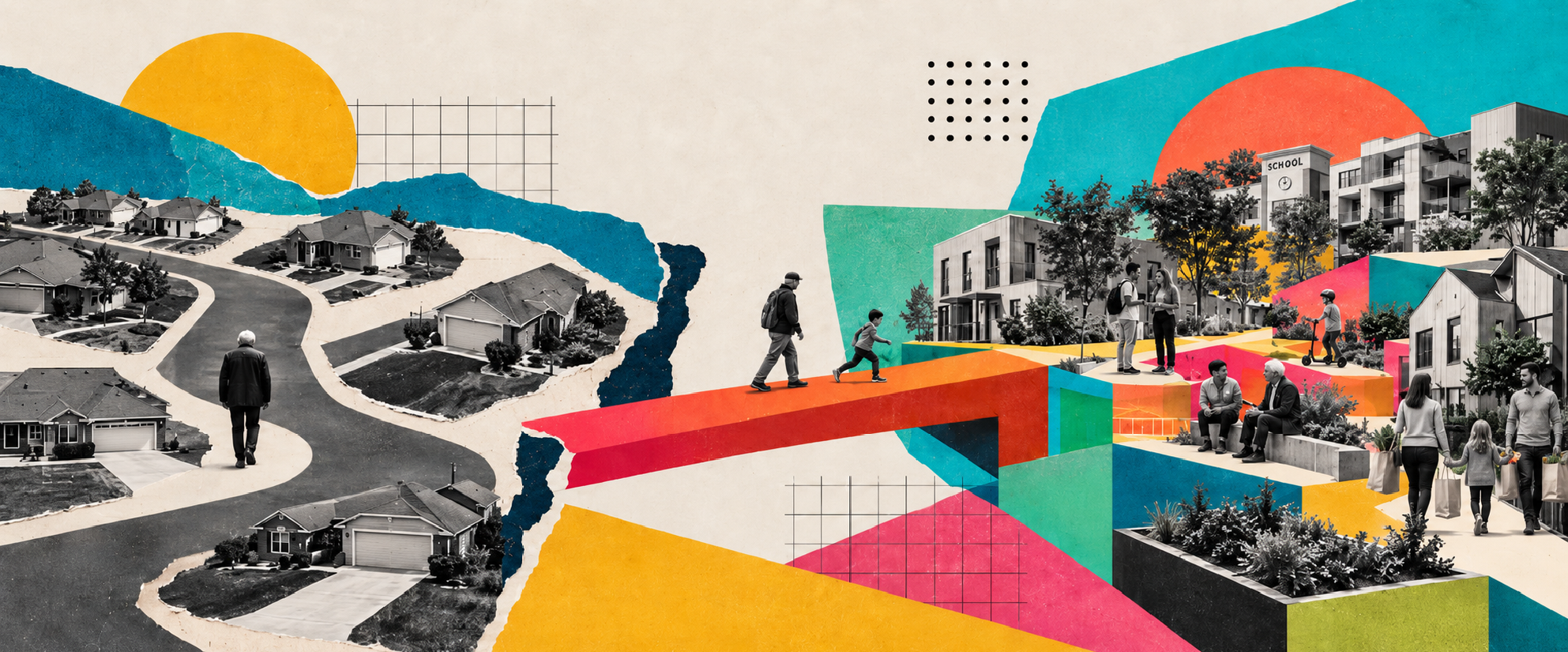
Age-segregated housing contributes to America’s family caregiving crisis, loneliness epidemic and loss of community. A new SCL Magazine series looks at solutions.
The U.S. housing market was never built for the country we’ve become. In the early 20th century, when only 4% of Americans lived beyond 65, the typical residence was a family farm, where generations lived together and were economically self-sufficient. As people left farms for cities and then for suburbs in the 1950s and 1960s, communities were designed — and financed by government-backed mortgages — almost exclusively for one kind of household: young, married with kids, and white. (Most Black World War II veterans were excluded from GI Bill housing benefits due to discriminatory local zoning restrictions.) By the 1970s, retirement communities began to sprout for a population that didn’t exist in earlier generations. That 20th-century design logic and the policies that drove it haven’t evolved much, despite dramatic social changes.
In 1970, 67 percent of Americans ages 25 to 49 were married and living with one or more children. By 2021, that share fell to 37 percent, according to the Pew Research Center. In place of the once dominant nuclear family structure, households of various sizes and constellations have become the norm. More Americans live alone than ever before (27.6 percent), according to the most recent U.S. Census. The U.S. fertility rate is at an all-time low. Home ownership, once the default marker for adulthood, is receding for younger generations. The average first-time homebuyer is now 40, a record high.
Meanwhile, millions of Baby Boomers, many intent on aging in place, are living out their later decades in the same car-centered suburbs built for their child-rearing years. These stories are usually told separately: the aging suburbanite rattling around in a four-bedroom house long after the kids have grown and flown, no longer able to safely climb stairs or drive; the young buyer or couple doing the math on a first home purchase and coming up short; people of all ages yearning for a deeper sense of connection and community.
We see aging, affordability and social isolation as facets of the same story. Americans of all ages are stuck in a broken housing market, pinched by tight supply, soaring prices and, above all, a mismatch between how people live now and the built environment inherited from the last century. If historic patterns are any guide, these trends are connected. A new working paper published by the National Bureau for Economic Research found that for every 1,000 new federally backed mortgages issued in peak Baby Boom years, there were about 300 additional births the following year. The NBER researchers’ finding is that housing finance policy correlates with birth rates, up and down.
Outdated policies, outdated models layered with current market realities, such as the mortgage lock-in effect, contribute to communities further sorting themselves by age, with profound consequences for everyone. These include a family caregiving crisis, a loneliness epidemic and the fraying of social cohesion that comes with any type of segregation. How communities of all sizes can address these challenges is the subject of our new series, “Places for Longer Lives.”
“Americans of all ages are stuck in a broken housing market, pinched by tight supply, soaring prices and, above all, a mismatch between how people live now and the built environment inherited from the last century.”
In this issue, David Wheeler reports on the booming market for aging-in-place renovations. Researchers at the University of Michigan found that 88 percent of adults between 50 and 80 consider it important to remain in their homes as they age — yet only 15 percent have seriously planned for the modifications that might make that possible. For many, renovation costs are prohibitive, and renters face additional challenges. While renovations may cost less up front than moving into assisted living, that doesn’t account for the costs of future in-home care, should it become necessary, or for other needs, such as social connection.
We’ll examine the growing, if still niche, world of intergenerational housing — from universities converting emptying dormitories into senior housing that brings retirees together with undergraduates, to platforms that match older adults with spare rooms and young people needing an affordable place to live. In this issue, Tamara Straus reports on a supportive “village” in rural Colorado housing two vulnerable populations: young people transitioning out of foster care and older adults at risk of homelessness.
KEEP READING
FIVE QUESTIONS
Elizabeth Coplan on Bringing Death to Life on Stage
FINANCING LONGER LIVES
What Do Generations Owe Each Other?
LONGEVITY LITERACY
DEEP DIVE
Our Households Changed. Our Neighborhoods Didn’t.
ALT/SHIFT
Aging-in-Place Renovation Boom
GAME CHANGER
Carlton Mason on the Power of an Intergenerational Village
@SCL: