
FINANCING LONGER LIVES
What Do Generations Owe Each Other?
By MP Dunleavey
It’s time to ditch the blame game for a social contract aimed at easing the generational wealth gap.
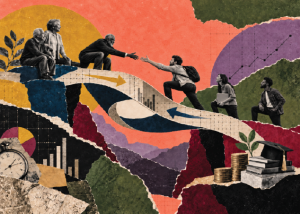
No one knows what to do with the Boomers. It’s as if the good fortune that buoyed this generation for much of their lives — a rising post-war stock market, educational opportunities, real estate gains — has cast a shadow on subsequent generations who haven’t, and aren’t, doing nearly as well.
One recent anti-Boomer screed has sparked a lot of debate: Samuel Moyn’s Gerontocracy in America: How the Old Are Hoarding Power and Wealth — and What to Do About It. The book not only rails against this generation’s luck and privilege, but hop-scotches into the premise that Boomers, the mega-generation born between 1946 and 1964, are somehow responsible for the economic struggles of Generation X and Millennials, who came along decades later.
Not only is this a strange spin at a complicated cultural moment, it fails to address a far more urgent question that millions of Americans are navigating right now. Wealth in this country is indeed concentrated at the upper end of the age curve, and the implications of that are profound — because longevity is changing what that disparity means for everyone.
Rather than a blame game, what we need are smarter ways to think about easing the generational wealth gap, from proactive methods of sharing wealth before you die (a.k.a. giving while living) and, perhaps more important, rethinking the social contract that got us here.
An Outdated Model of Aging
The economic pressure that comes from living longer cuts both ways. Many older people today are holding onto their assets because they’re worried about covering the cost of much longer lives (and they don’t want to be a burden on their kids). At the same time, younger generations are struggling to find their financial footing — even as the specter of a potential 40-year retirement looms.
Rather than put the blame on those wealth-hoarding Boomers, as Moyn does, we first need to acknowledge that the social contract for aging, itself, is showing signs of age, says James Chappel, an associate professor of history at Duke. “One big problem is that aging parents and adult children seldom see themselves as part of the same economic unit,” says Chappel, author of Golden Years: How American Invented and Reinvented Old Age.
“The truth is, there’s so much intergenerational interdependence, and yet it’s hard for us to actually talk about what we owe each other as we age.”
Chappel points out that the prevailing contract was built on the dogma of self-propelled success. Going to school for 20 years, working and saving for about 40, and retiring at 65 played out well for many Baby Boomers, who control about 51 percent of U.S. household wealth, according to Federal Reserve data — a mind-blowing $90 trillion in assets. But it hasn’t worked that way for everyone. By comparison, Gen Xers control 26 percent of household wealth and Millennials about 11 percent.
Nonetheless, that model of self-driven success was canonized during the postwar boom, even if it was circumstantial. Older generations have had a pretty long runway, and they’ve benefited from decades of a mostly rising stock market plus soaring property values. And, let’s not forget, many had relatively stable jobs that came with a pension.
Sharing Wealth Now vs. Later
To be sure, most Boomers are not wealthy, and the real fortunes belong to a small percentage of people at the peak, as they do across all generations. Wealth inequalities are not new.
What is new is how much longer many people are living, and the financial reckoning that longevity brings with it. The oldest millennials are in their mid-forties; Gen Xers are staring down retirement. These 40-, 50- and now 60-somethings are trying to save for their own (longer) old age, put kids through college, and — for many — help care for elderly parents, a role that’s typically unpaid.
Meanwhile, money and assets that used to change hands when one generation passed away are in a holding pattern: controlled by older adults who need it for their own survival, and wanted by middle-agers who could use a leg up.
What to do?
“Giving while living” has become a bit of a catchphrase in the financial world in recent years, as the idea of sharing wealth now versus providing an inheritance has gained traction in families with the means to do so. For example, only about a third of families saving for college use a 529 plan. Yet a grandparent can also fund a 529 for a grandchild’s education, and in most cases get a break on state taxes.
Or, if that grandchild has earned income from babysitting or mowing lawns, their parent or grandparent can open a custodial Roth IRA and give that child a retirement account decades ahead of schedule, says Mitchell Kraus, CFP, a cofounder of Capital Intelligence Associates in Santa Monica, California.
If giving an adult child money for a down payment feels onerous, how about a low-interest intra-family loan? “It’s a way to make both generations a little wealthier,” Kraus says.
It’s not nothing to help your kids stand on firmer ground — especially if you’ll be the one who needs them someday.
An Argument for Interdependence
A more intriguing idea — and one with the potential to shift things on a macro level — is Chappel’s idea of renegotiating the social compact that has long set expectations around aging, wealth and generational relationships. That model worked when old age was a brief final chapter. It’s a poor fit now, when people live into their eighties and nineties, often with complex, expensive, chronic conditions.
“What if that reciprocity became part of the conversation between generations and included expectations about sharing assets, resources and compensation?”
Chappel asks: Why should the assumption be that you go it alone from 65 until the end? Why isn’t it normal for families and communities to help one another across that long span, in both directions? What if that reciprocity became part of the conversation between generations and included expectations about sharing assets, resources and compensation? These conversations aren’t generally considered part of the American ethos, and yet they are, and historically were, an integral part of many cultures right here in the U.S.
A revised compact around work, retirement and aging — one that assumes mutual support rather than solitary endurance — wouldn’t just support the young. It would hand the old the very thing all that tightly held wealth was supposed to provide in the first place: the freedom to meet the last stage of life with confidence, not dread.
KEEP READING
FIVE QUESTIONS
Elizabeth Coplan on Bringing Death to Life on Stage
FINANCING LONGER LIVES
What Do Generations Owe Each Other?
LONGEVITY LITERACY
DEEP DIVE
Designing Neighborhoods for the Future
ALT/SHIFT
Aging-in-Place Renovation Boom
GAME CHANGER
Carlton Mason on Intergenerational Supportive Housing
@SCL:
- Design Challenge: Human-Centered Robotics
- Exploring the Paradox of Longer Lives
- Is College Still the Path to Prosperity?
Enjoying SCL Magazine?
MP Dunleavey is an award-winning journalist, columnist for SCL Magazine and a regular contributor to the Kiplinger Retirement Report.
RELATED ARTICLES
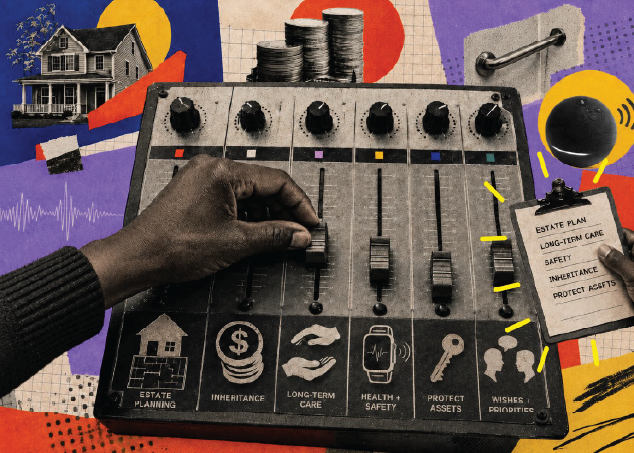 What Aging Parents Want the “Kids” to Know
Dignity and desire for control go hand-in-hand with money decisions.
Read more
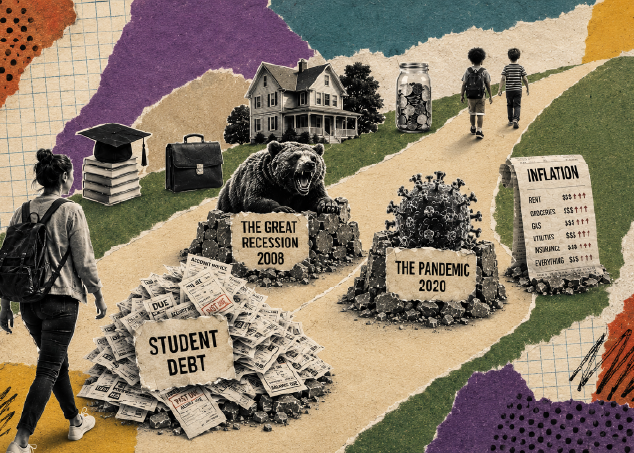 Millennials Reach Key Milestones Later
College debt, recession, the pandemic and other challenges have made it tougher for this generation to build wealth.
Read more
 How to Balance Love and Money Decisions
As we grow older, it’s important to honor the financial and emotional dimensions of our choices.
Read more
 You Need a
 Financial Longevity Planner
Industry surveys of advisers and clients reveal planning gaps.
Read more