
@ SCL
Exploring the Paradox of Longer Lives
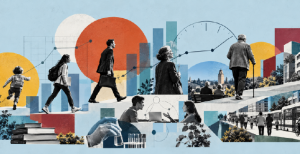
Scientific advances have delivered something humans have dreamed about for centuries: the gift of time. But what happens when those advances add decades to people’s lives and societal structures don’t evolve to meet them?
This question was at the center of Stanford Longevity Day on September 24, a gathering of faculty, researchers and New Map of Life fellows focused on what it will take to make longer lives healthy, rewarding and more equitable. The convening was organized around four challenges:
- extending healthspan, the years spent in good functional health
- building financial resilience
- investing in future generations of centenarians
- creating communities for longer lives
SCL Director David Rehkopf opened the day with a reminder of just how extraordinary the longevity transformation has been. When Thomas Hobbes described life as “nasty, brutish and short” in 1651, life expectancy was about 38 years. By 1900, it had reached roughly 47 in the United States and Britain; by the end of the 20th century, it was about 77. Yet starting in 1980, lifespans in the U.S. have not kept pace with other high-income nations.
“Compared to global trends, the United States during the first quarter of the 21st century has been experiencing a tragedy of an unfathomable scale,” Rehkopf said, citing his recent JAMA commentary. “Americans are dying younger — with 314 million years of life lost between 1999 and 2022.” In some U.S. counties, he noted, life expectancy reaches 87, while in others it’s just 66 years.
Rehkopf challenged the audience to analyze longevity as much more than a medical achievement and to focus as well on education, work, financial security, housing, transportation, climate and the design of communities. He said SCL’s New Map of Life initiative grew out of this recognition: that the traditional model of life — with intensive education early on, decades of work and then retirement — may no longer fit societal needs.
The Center’s Sightlines Project offers a window into what that mismatch looks like. SCL research director Yochai Shavit presented Sightlines data covering 2019 to 2023 showing deterioration across six of nine measures of social and emotional well-being. Americans reported fewer interactions with family, friends and neighbors, lower rates of volunteering, and increases in anxiety, depression and poor mental health. Young adults, ages 25 to 44, experienced some of the sharpest declines. Shavit noted that the data identify trends, rather than underlying causes. The next step, he said, is to determine what is driving down well-being and develop interventions.
Stanford economist Maya Rossin-Slater shared her research finding that inequality begins before birth. According to California birth data from 2007 to 2016, infant mortality among babies born to mothers in the bottom 5 percent of the income distribution was twice that of babies born to mothers in the top 5 percent. Also, inequality at birth becomes inequality across the entire life course — affecting education, employment, health and economic outcomes — and into the next generation.
Financial security presents another life-course challenge. Natalya Guseva of the World Economic Forum noted that nearly 40 percent of people experience financial instability following an unplanned career interruption, and globally up to 25 percent of people 55 and older wish to continue working but find limited opportunities. Midlife, she said, is particularly consequential: Decisions and disruptions involving work, caregiving, health and finances can shape security for decades.
Jialu L. Streeter, a senior research scholar at Stanford’s Institute for Economic Policy Research, shared data showing that almost 70 percent of working Americans worry they will not have enough money for retirement. Streeter also highlighted how unequal access to wealth-building tools compounds existing income inequality.
Yet Longevity Day speakers offered many ideas to counter these challenges. Streeter and Ryan Moore, a former SCL fellow and assistant professor in the iSchool at University of Texas at Austin, argued that time is one of young people’s greatest financial assets: Early savings and investment can compound over decades. Ronjon Nag, founder of the R42 Group and an adjunct professor in genetics at Stanford Medicine, presented a moonshot initiative to develop an AI-driven “all-in-one” off-the-shelf vaccine for aging. Rossin-Slater and Jonas Miller, assistant professor of psychology at the University of Connecticut and a former SCL fellow, underscored that nurturing environments for children have lifelong benefits. And Nic Palmarini, director of the UK’s National Innovation Centre for Ageing, shared a platform that helps communities plan longevity interventions and share knowledge globally.
The question posed by these longevity scholars for fellow researchers, policymakers and others is not merely how many years of life people gain, but whether they have the health, relationships, financial resources and social connections to make good use of them.
KEEP READING
FIVE QUESTIONS
Elizabeth Coplan on Bringing Death to Life on Stage
FINANCING LONGER LIVES
What Do Generations Owe Each Other?
LONGEVITY LITERACY
DEEP DIVE
Our Households Changed. Our Neighborhoods Didn’t.
ALT/SHIFT
Aging-in-Place Renovation Boom
GAME CHANGER
Carlton Mason on the Power of an Intergenerational Village
@SCL:
Enjoying SCL Magazine?