
FIVE QUESTIONS
Elizabeth Coplan on Bringing Death to Life on Stage
By Karen Breslau
The self-styled Diva de la Muerte is shifting the culture around dying through immersive theater.
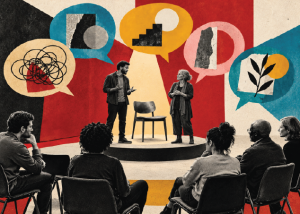
After caring for her terminally ill cousin, Elizabeth Coplan turned a family letter about her cousin’s final days into a short play and submitted it to a contest, which she won. Her prize, a theater workshop of her piece, inspired deep conversations among audience members. “It gave them permission to share their own stories,” Coplan says. “I thought, well, if my one little story can create this, what would six little stories from six different playwrights about six different situations be like?”
Coplan left her corporate career to find out. In 2016, she created the Grief Dialogues, a series of short plays that debuted at the Seattle Death Salon in 2017. Coplan chose the title as a twist on “The Vagina Monologues,” the hit 1996 one-woman show by Eve Ensler that brought another taboo topic to the stage.
Over the past decade, Coplan has transformed The Grief Dialogues into an interactive theater nonprofit to explore dying, death and grief. One new work, In Honor: We Hold the Line, is about the experience of veterans; another, Our Loving Companions, is about the unique pain of losing a pet. The plays have been performed across the U.S. in dozens of unusual venues: a funeral home in Manhattan, a medical school and a death salon in Seattle, as well as art galleries and community centers. The project has won numerous awards, and turned into a book and screenplay. Coplan calls herself a “grief dramaturg” and signs her emails Diva de la Muerte.
This interview has been edited for length and clarity.
Who are we in dialogue with when it comes to grief? Is it with ourselves, with the person we’re missing, with each other?
All of the above. It’s the grief you feel when you lose someone. It’s also your own grief from the knowledge that you’re going to die. And maybe you’ve received a diagnosis or you hit an age where chances are you don’t have that many years left. I think giving people the opportunity to think about how they want their own life to be, or how they want to honor a loved one, is important. And they really get into the conversation and want to share their stories and want to ask questions.
How did you come up with the idea of staging performances in a funeral home, and how have audiences responded?
A few years ago Grief Dialogues was going gangbusters and I partnered with Dani Davis, an Emmy Award–winning director, to take the show to the next level. We were taking it to medical schools, hospitals. But after Covid, people don’t want to sit and be immersed in something that’s going to make them cry.
They need to move. They need to have agency. So Dani came up with this immersive experience that we now call In the Wake of Life. It starts with a play where everybody’s together watching it; it ends with another play that everybody’s watching; and in between, there are sets of plays. People have an opportunity to choose which one they want to go to. So it’s kind of a choose-your-own-adventure type of situation. Some of the plays are very funny.
Then someone introduced me to Bill Villanova Campbell Funeral Home in Manhattan, which is the funeral home to the stars in a very beautiful building. He was trying to make the funeral home more of a community center, with book readings and even a jewelry show. Using it for people to talk about death, dying and grief was kind of a no-brainer. We had space for 100 people and 120 signed up.
In the 10 years since you launched the project, what common themes emerge?
People realize that even though grief may be very complicated, debilitating, spiraling you in all kinds of ways that aren’t good, you can’t grieve if you didn’t love. It’s not physically possible. People come away from the show realizing how much love they had for the other and realizing that, while their lives maybe have not been perfect, they’re happy to be alive now. I often get a “Boy, I’m going to go home and hug my husband.” The experience makes us appreciate the love we do have in our lives and the time we have with our loved ones.
What sort of broader shifts have you seen in our culture where death, maybe with the exception of the Covid pandemic, is pretty walled off?
I’ve seen some big shifts, which I absolutely love. Our first big production with the Seattle Death Salon brought out goth, end-of-life type people, wonderful people, absolutely fabulous people, who didn’t have any problem talking about death, who were very open, very loving. But that’s about the only people who would talk about it. There was even a stigma around going to grief counseling. So they kind of broke the ice, but for a long time, it was not in the general culture to talk about death and dying.
I think a cultural shift is starting to happen. Death is the great equalizer. No one is going to be spared death. No matter how much money they have, no matter the color of the skin, no matter nothing, we are all going to die. It’s our common denominator. And if we can come together as a group of people who are going to die and see each other for that fact and embrace each other, the world will be a much better place.
The number of Americans who participate in organized religion is at an all-time low. Does that affect the mainstreaming of curiosity around death?
I think so. I was raised Catholic, my husband is Jewish, and we raised our boys Jewish. Although we’re not church- or synagogue-goers so much, we do practice the heritage and the religion. I grew up in a very Catholic family, and my mother’s religion really sustained her during some very, very dark times. So I don’t have anything negative to say about organized religion. It’s just not for everybody. Having all these options is really beneficial to people, because when you do have a memorial, there’s a community that comes together. I’ve been to some pretty fun memorials, and my husband and I have talked about what mine will be like. I don’t care about food. I just want to make sure the champagne is flowing.
My friend Lisa Pahl, who is a hospice nurse, created a fun card game with her partner called The Death Deck. You talk about parts of your life that you may not have shared with anybody. A question might be, “What was the most exciting thing that ever happened to you?” And you can’t say marriage, children, the usuals. People have to stop and think about it. The idea is just to get the conversation going. And that’s what Grief Dialogues is all about.
KEEP READING
FIVE QUESTIONS
Elizabeth Coplan on Bringing Death to Life on Stage
FINANCING LONGER LIVES
What Do Generations Owe Each Other?
LONGEVITY LITERACY
DEEP DIVE
Our Households Changed. Our Neighborhoods Didn’t.
ALT/SHIFT
Aging-in-Place Renovation Boom
GAME CHANGER
Carlton Mason on the Power of an Intergenerational Village
@SCL:
Enjoying SCL Magazine?
Karen Breslau is editor of SCL Magazine.
For a performance schedule and tickets visit https://www.griefdialogues.com/events.
RELATED ARTICLES
 Why the “Good Death” is Having Its Moment
Death doulas, death cafés and candid conversations are reshaping how we face life’s end.
Read more
 Making Time to Talk About Life’s End
“It’s always too soon until it’s too late,” says the founder of the Conversation Project.
Read more
 Hey, Stranger … The Power of Investing in the Older You
Why connecting with your future self may be the most important relationship in your life.
Read more