
ALT/SHIFT
Making Time to Talk About Life’s End
By Chloe Veltman
“It’s always too soon until it’s too late,” says the founder of the Conversation Project.
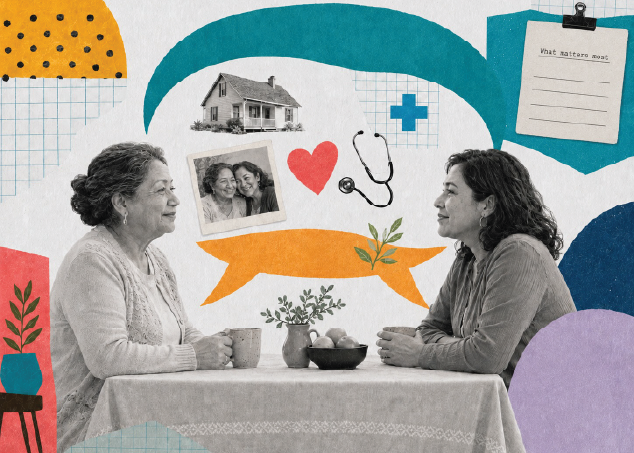
For decades, the American approach to the end of life has been framed as a series of legal or financial checklists and advance directives, often sequestered in dusty filing cabinets or their digital equivalent. But a quiet revolution is taking place around kitchen tables and living rooms across the country. Led by the Conversation Project, the focus is shifting away from “What’s the matter with you?” toward a more profound question: “What matters to you?”
A public engagement initiative with a mission to help people share their wishes for care through the end of life, the Conversation Project was founded in 2010 by Pulitzer Prize–winning journalist Ellen Goodman, in the wake of her own experience of feeling unprepared for her mother’s final days. “I wished I had heard my mother’s voice in my ear telling me what she would have wanted,” Goodman says in her 2013 TEDx Talk. “It’s always too soon until it’s too late.”
The nonprofit has since grown into a movement dedicated to normalizing discussions about end-of-life wishes long before a medical crisis occurs. A 2018 national survey conducted by the Conversation Project found that while more than 90 percent of the 1,000 people surveyed said they believe discussing end-of-life planning was important, only 32 percent actually did so. Despite this, 53 percent said they would feel “relieved” if a loved one initiated the conversation. For the Conversation Project, the goal of these discussions is to provide a sense of control over an uncertain future.
“We didn’t used to have much of a say in how the end of our lives played out,” says Kate DeBartolo, senior director of the Conversation Project. “As medicine has gotten more advanced, there are a lot more decisions to be made,” she says. “Wanting to know what would matter to a patient is really important to the healthcare team — and to their family members.”
The focus is shifting away from “What’s the matter with you?” toward a more profound question: “What matters to you?”
Prioritizing Personal Values
The U.S. medical system generally defaults to doing everything possible to keep someone alive. That could include CPR, breathing tubes or admission to the ICU. “If someone doesn’t want those things, they should be noted in an advance directive,” DeBartolo says.
By moving these discussions from the ICU to patients’ homes, the Conversation Project helps families navigate the complexities of modern medicine — with a focus on personal values.
“This is coming from a place of ‘You are the most important person to me, so I have to know what you want,’” says Molly Galler, a Boston-based public relations professional who used the Conversation Project’s resources after her father was diagnosed with prostate cancer in 2017.
“As someone who writes professionally, I don’t typically need a script, but I did for this,” Galler says. “Having a professional opinion on how to try to initiate a conversation with my dad about his wishes gave me more confidence to do it.”
Galler says she felt responsible for caring for her aging parents, but was also wary of talking about mortality with them. Galler says using the nonprofit’s free tools, such as its “Starter Guide” — a downloadable PDF containing scripted prompts to help people talk about their values and priorities when it comes to end-of-life care — helped her frame the conversation not as a morbid necessity but as an act of love. The guide asks users to complete sentences, like “What matters to me through the end of my life is …” and respond to questions such as “What specific information would you want (or not want) shared with certain trusted people?”
“To have your adult child say, ‘Whatever you want, Mom and Dad, I’m going to make it happen,’ brought a different level of closeness and maturity as a family that we hadn’t had before,” Galler says.
A Critical Planning Deficiency for the Inevitable
For medical professionals like Dr. Mehrdad Ayati, a geriatrician at Stanford, organizations like the Conversation Project fill a critical deficiency in the healthcare system. He says that by establishing a values-based plan for care early on, families can avoid the trauma of making high-stakes decisions in the rush of the emergency room. “At that point, you don’t hear it very well,” Ayati says.
But he adds the shift toward families engaging in these conversations is not yet as commonplace as he’d like. “We still see a lot of frail, elderly people being shuttled back and forth like a ping-pong ball from facilities to emergency rooms, getting a lot of really unhelpful medical care that has nothing to do with the quality of life,” Ayati says.
The Conversation Project’s DeBartolo says outreach is a challenge. With end-of-life planning historically being the province of the upper-middle-class white demographic, her organization is actively working to diversify its audience through partnerships with such groups as the Chinese American Coalition for Compassionate Care, as well as by making its materials available in different languages. A creative commons license allows users to adapt them to suit their communities’ needs. “The thing that’s been interesting to me is how many folks will say, ‘In my culture, there are taboos around talking about end of life,’” DeBartolo says. “But actually, that’s the universal experience.”
DeBartolo says she feels hopeful about a growing acceptance of these traditionally off-limits conversations, owing in part to the groundswell of cultural interest in the topic.
DeBartolo points to the fact that there are a number of groups with missions similar to that of her own like End Well, the rise of death doulas (including actress Nicole Kidman, who recently announced her plan to train to become one), and the popularity of the TV show The Pitt. One of the show’s storylines features a night-shift charge nurse (Lena Handzo, played by Lesley Boone) who moonlights as a death doula. “They are handling these conversations so well,” she says of the medical drama, which concluded its second season in April. “I am in favor of anything that helps people understand better what their own values are and how to talk about them.”
The thing that’s been interesting to me is how many folks will say, ‘In my culture, there are taboos around talking about end of life,’” DeBartolo says. “But actually, that’s the universal experience.
DeBartolo also notes the rise around the country of Medical Aid in Dying (MAID) legislation, a regulated practice allowing terminally ill, mentally capable adults with a prognosis of six months or less to live, to end their own lives using medication. MAID is currently legal in 13 states and Washington, D.C.
While DeBartolo says the Conversation Project has always been neutral on MAID — “everyone’s preferences are unique” — she concedes the importance of its growth in helping to further conversations about end of life care. “As more states offer a legal option for MAID, we are working to create a neutral supplement that would help people understand this option and discuss it with those they trust.”
KEEP READING
FIVE QUESTIONS
Andrew Scott on Baby Busts and Growth Booms
ALT/SHIFT
Making Time to Talk About Life’s End
DEEP DIVE
Rebuilding the On-Ramp to Adulthood
GRANDPEOPLE
The Traveling Nanas
GAME CHANGER
Lucy Marcil on Money as Medicine
FINANCING LONGER LIVES
What Aging Parents Want the “Kids” to Know
LONGEVITY LITERACY
Palliative Aesthetics
@SCL:
- Sightlines Project Reveals Paradoxical Pattern in Americans’ Health Behaviors
- Bernardo Mackenna: How Bodies “Tell the Story”
- Making Sense of Peptide Mania
Enjoying SCL Magazine?
Chloe Veltman is a staff correspondent on NPR’s culture desk. She is based in San Francisco.

Why the “Good Death” Is Having Its Moment
Death doulas, death cafés and candid conversations are reshaping how we face life’s end.
Read more

Being Mortal: Medicine’s Most Vital Lesson?
A novel Stanford course teaches students how understanding life’s limits can help them become better doctors.
Read more

Gratitude Adds More Than Years
How an age-old practice rewires our brains to favor good memories over bad.
Read more