DEEP DIVE

Rebuilding the On-Ramp to Adulthood

By Dawn M. Carpenter

Young Americans are missing out on a vital decade of career- and relationship-building that sets their futures in motion. The costs will compound for decades if we don’t make changes.

Catherine Collinson remembers the 50 dollars. Her first job after college was, as she puts it, “huge for experience, not great for the paycheck.” The pay was modest enough that she qualified for tax-credit-subsidized housing, trimming about $50 from her monthly rent.  “That little bit made a big difference,” she says. So did the job itself. 

Collinson had already bought a car while in college so she could get to interviews and, eventually, to work. After graduation came roommates, then her own apartment, additional classes, new skills and better jobs. No single step transformed her life. Together, they gave her traction. 

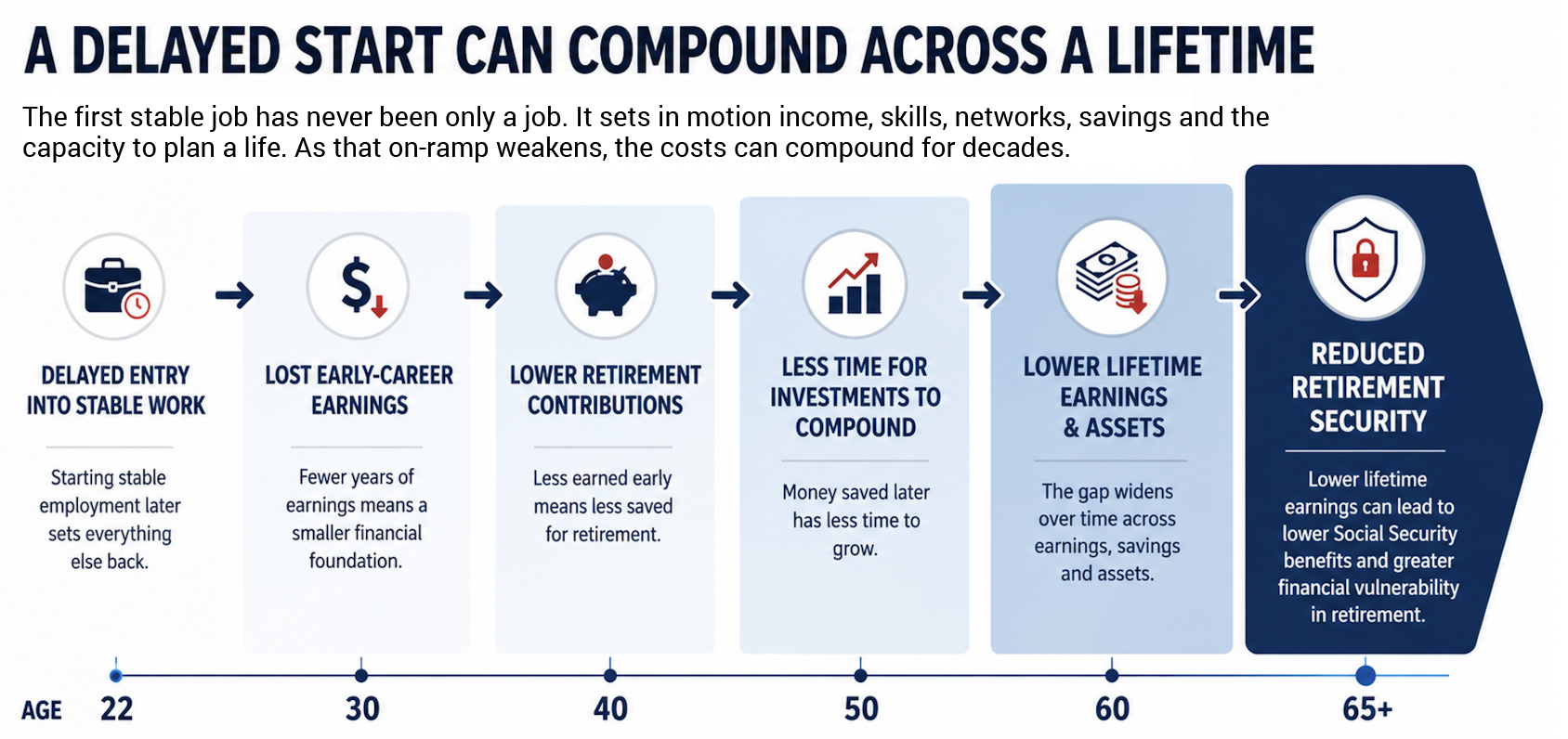
Today Collinson is the founding CEO and president of the nonprofit Transamerica Institute, where she studies how Americans prepare for longer lives. When we talked about getting an early start, she turned right away to compound interest: Money saved at 20 has something money saved at 30 does not: an extra decade to grow. Starting later does not make catching up impossible, but it makes the climb steeper. 

Money is not the only thing that compounds. Skills do. Relationships do. So do credit history, professional reputation and the practical knowledge of how institutions work. A supervisor becomes a reference. A paycheck makes rent possible. Benefits cushion a medical bill. Savings make a layoff survivable. One foothold makes the next easier to reach. 


Enjoying SCL Magazine?
Stay informed about the ideas, research, and people shaping longer lives.


The trouble with much of our advice to young adults — start saving, start networking, start building experience — is that it assumes there is somewhere to start. In the second quarter of 2026, unemployment among recent college graduates stood at about 5.6 percent, while 42 percent were underemployed, working in jobs that typically do not require a college degree, according to the Federal Reserve Bank of New York. For more than four in 10 recent graduates, then, the problem is not simply finding work. It is finding work that begins to build on what they have learned and opens the way to what comes next.  

What is becoming harder to secure is not simply employment. It is employment that starts something. 

What a First Job Starts

A stable first job has long been one of America’s gateways into adult economic life, often bundling a paycheck with training, benefits, networks and greater credibility with landlords and lenders, not to mention future employers. This system was never universal or fair; and arguably a worthy adulthood should not be measured by whether someone marries, buys a home or becomes a parent on a specific schedule. Nevertheless it is the case that stable first jobs, relationships and households tend to be anchors of healthier, happier, more prosperous lives. 

In 1975, 45 percent of Americans ages 25 to 34 were working, living outside their parents’ home, married and living with children. By 2024, fewer than one in four had reached all four milestones, according to the Census Bureau. The shift reflects several broad changes, including greater educational attainment, women’s increased labor-force participation, higher living costs and changing family patterns. Freedom from an old script is progress, but it is not freedom from the need for scaffolding. 

Young adults still need income before they can save, and they need jobs before employers will consider them experienced. They also need access to opportunity. This means relationships beyond family and school and enough stability to decide where to live, whether to pursue more education, whom to care for and how much risk they can afford to take. Increasingly, young adults are expected to assemble those prerequisites themselves, often with whatever help their families can provide: build the network, acquire another credential, master new technology, establish credit, save for retirement, find mentors and somehow gain experience before anyone is willing to hire them. 

In the second quarter of 2026, unemployment among recent college graduates stood at about 5.6 percent, while 42 percent were underemployed

In that sense, the work of becoming an adult is increasingly privatized. Young people and their parents are expected to compensate for gaps in affordable housing, training, transportation, professional networks and entry-level opportunities. In 2025, 47 percent of Americans ages 18 to 29 received help from someone outside their household to pay an expense during the previous 12 months, according to the Federal Reserve. 

The necessity of family support for young adults starting out on their own is hardly new. But when the runway to independence lengthens, family resources can buy something more consequential than money: time. Time to take the internship, live in an expensive city, acquire another credential or recover from a false start. Those without that cushion have less room to wait. The inequality is not only in who earns more. It is in who can afford more time to become. 

The Great Compression

The “missing decade” does not mean that young adults make no progress between 22 and 32. Most work, learn, care for others, build relationships and improvise. The loss is subtler: Many of the things that benefit most from an early start have less time to accumulate. 

In 2025, only 37 percent of adults ages 18 to 29 had enough savings to cover three months of expenses. Just 22 percent believed that their retirement savings were on track. A late start therefore matters twice. There are fewer years to accumulate and fewer resources to protect what has already been saved. A car repair, a layoff or a family emergency competes with the same dollars intended for debt repayment, a down payment and retirement. 

Then another stage arrives. Student debt, housing, saving and perhaps children can converge with the first serious needs of aging parents. A worker who has only recently found stability may suddenly be asked to reduce hours, provide care or absorb a health shock. Delay becomes compression: Obligations that might have been spread across decades begin competing for the same dollars and hours. 

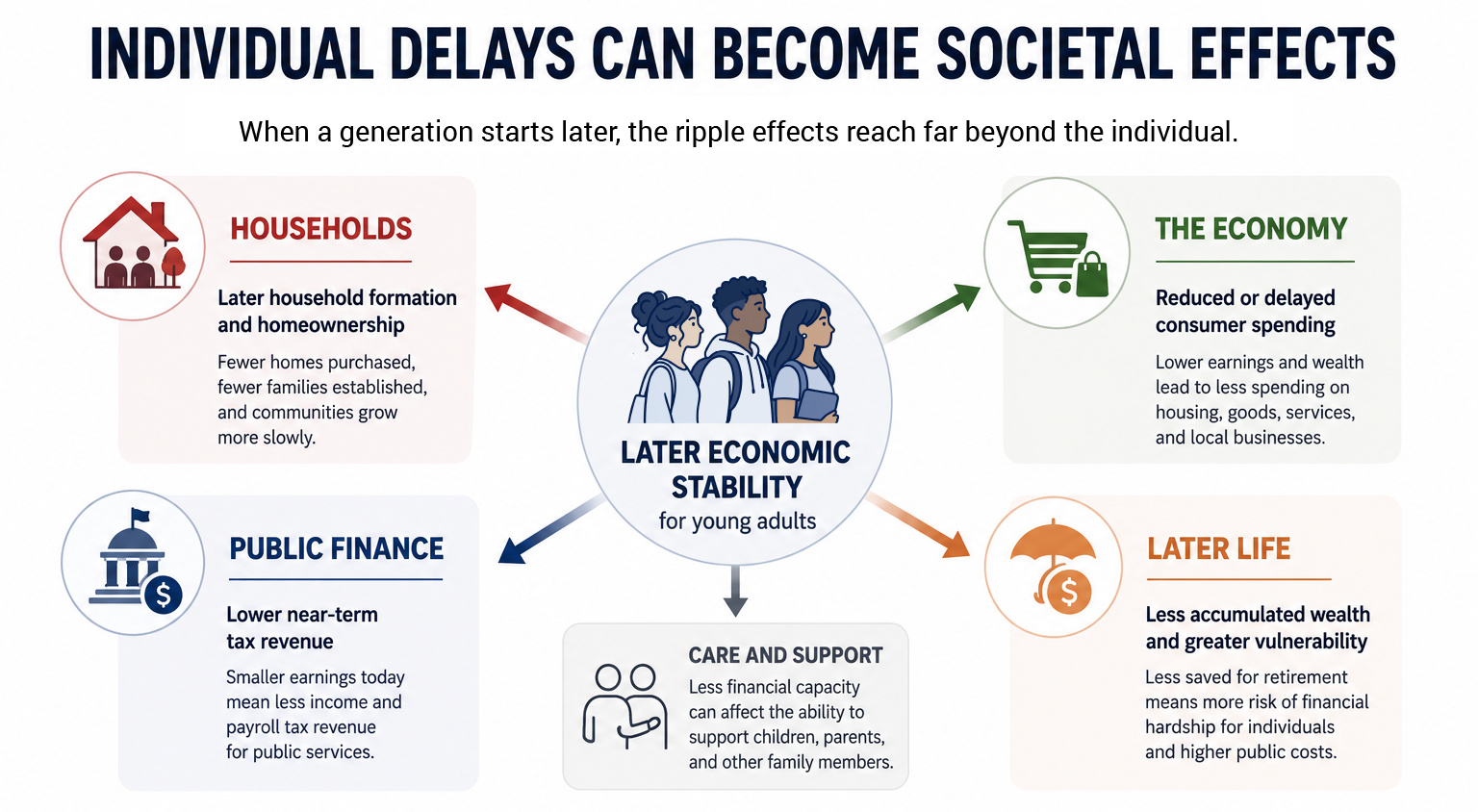
The effects ripple outward. Relatively affluent families are more likely to finance prolonged transitions for their young adults, magnifying advantages that existed at birth, while those from less advantaged households fall farther behind. Later independence can also delay the point at which young adults put down economic and social roots in a community — forming friendships, joining civic or faith organizations, volunteering, mentoring, coaching, participating in local institutions or eventually taking on leadership roles. 

Employers face their own version of the problem: Those that stop developing junior workers risk running short of experienced ones. Even social connection belongs in this story. Workplaces can create ties to colleagues, mentors and acquaintances beyond a person’s closest circle. Those ties can lead to another job, but they also teach people how to inhabit institutions and locate themselves in a larger world. A 100-year life does not make these early decades less consequential. What begins early has more time to shape what follows. 

Later independence can also delay the point at which young adults put down economic and social roots in a community — forming friendships, joining civic or faith organizations, volunteering, mentoring, coaching, participating in local institutions or eventually taking on leadership roles.

The Disappearance of Beginners

The erosion is not only financial. Workplaces once contained more learning terrain: assignments important enough to teach, but forgiving enough to survive mistakes. 

A junior employee drafted the first memo, checked the numbers, sat in meetings and listened. Beginners are inefficient. They need supervision. They ask questions whose answers seem obvious to people who have forgotten what it was like not to know them. Yet every profession depends on someone absorbing that inefficiency, because expertise does not reproduce itself. 

Artificial intelligence sharpens the dilemma. Stanford Digital Economy Lab researchers have found a 19 percent relative decline in employment among workers ages 22 to 25 in the occupations most exposed to generative AI, even after controlling for company-level shocks. However, employment among more experienced workers in those same occupations remained stable or continued to grow. 

AI is not the sole explanation for the early-career slowdown. But many of the tasks easiest to automate, including the first draft, basic research and routine analysis, are also how beginners have traditionally learned the grammar of a profession. Eliminating pointless work is progress. Eliminating the learning hidden inside it is something else. 

Richard Arnold saw what that learning can still look like. A finance and quantitative economics student at Salisbury University in Maryland, he spent the summer at the AFL-CIO Housing Investment Trust through the Labor Capital Strategies Fellowship, run by Heartland Capital Strategies and Georgetown University’s Kalmanovitz Initiative. He did consequential analysis, drafted memos, absorbed corrections and learned workplace habits that insiders barely notice. 

When Arnold had a question and the right colleague was in the office, he could walk over and ask. “Everyone is pretty close by,” he says. On days when both supervisors were remote, the alternative was to “send an email and just pray I get a response.” He watched coworkers gather around problems and reason through them together. By summer’s end, he was more comfortable approaching people outside his team. He was learning not only finance but how professional life happens. 

There was also the price of admission. Commuting from Rockville to Washington cost almost $18 a day. Asked whether he could have taken the internship unpaid, Arnold says that, knowing what it costs just to get to Washington, “definitely not.” He estimates he would have spent roughly $800 “just to go work there,” which he calls “not feasible.” 

The fellowship pays its participants and gives them real assignments, orientation and access to practitioners and peers. Debbie Nissen, co-chair of Heartland Capital Strategies’ governing board, calls part of the problem a “cultural gap”: People enter workplaces without understanding the acronyms, institutions and assumptions that insiders take for granted. 

One fellow began his placement a couple of weeks before attending Heartland’s orientation. Afterward, he told Nissen that conversations he had spent weeks struggling to follow suddenly made sense. That is what an on-ramp does. It makes the invisible visible. 

Nissen would like to expand the fellowship, as 130 people applied for 10 Heartland positions this year. The obstacle is not finding young people willing to learn. It is finding more places willing to let them.

AI is not the sole explanation for the early-career slowdown. But many of the tasks easiest to automate, including the first draft, basic research and routine analysis, are also how beginners have traditionally learned the grammar of a profession.

Who Builds the On-Ramp?

That shortage exposes a larger problem. Every organization wants experienced workers. Each has an incentive to let somebody else bear the cost of creating them. A new on-ramp does not require a national program or a return to 1975. But it must perform three functions too important to leave to chance: pay the beginner, teach the beginner and connect the beginner to what comes next. 

Pay matters because opportunity that requires parental subsidy excludes too many. The skilled trades have long understood the bargain: A person can be productive and unfinished at the same time. More than 700,000 active apprentices participate in Registered Apprenticeship programs across the country. The model is also expanding beyond the traditional trades into fields such as technology, advanced manufacturing, supply chain and transportation. Learning can happen through paid work rather than being a toll paid before work begins. 

Teaching matters because a healthy labor market should not judge an entry-level job only by what the worker produces. It should also ask what the job produces in the worker. A good beginning offers real responsibility, correction, exposure to experienced people and progressively more challenging work. Collinson puts it more directly: a good employer pays “a competitive wage and competitive benefits” and, especially early on, helps workers “gain as much experience as possible as quickly as possible” through assignments of increasing difficulty and complexity. 

Connection matters because no first job can guarantee a career. It can provide the next foothold: a reference, a credential, a relationship, a body of work, someone willing to say, “I’ve seen what she can do.” Heartland matters not because 10 fellowships can repair the labor market, but because it makes those functions deliberate rather than accidental.  

No employer has to do all of this alone. Colleges, unions and industry groups can share training, mentoring and networks. Arnold’s $18 commute is a reminder that mundane barriers such as transportation can determine who gets through the door. What matters is ending the quiet assumption that cultivating beginners is a cost every institution can push onto someone else. 

Artificial intelligence belongs inside that bargain. If a machine can write the first draft, let the beginner learn to find what it missed. If it can perform routine analysis, move junior workers sooner toward judgment and harder problems. Younger employees may bring greater fluency with AI, while more experienced colleagues contribute context, judgment and institutional knowledge. AI should raise the floor of what a beginner can do, not pull up the ladder behind them. 

What matters is ending the quiet assumption that cultivating beginners is a cost every institution can push onto someone else.

The need for on-ramps will not end at 30. Caregiving, illness, layoffs and technological change will make beginners of people at 42 and 62 as well as 22. A 100-year life will require more ways to move in and out of work, learning and caregiving, and more chances to start again. The first rung remains special because it starts so much else. 

Collinson remembers the $50 because adulthood rarely arrives as one grand transformation. More often, it is assembled from small footholds: the rent break, the car that gets you to work, the first paycheck, the colleague who answers a question, the person willing to give you responsibility before you have fully proved you deserve it. None is life-changing on its own. Together, they create momentum. Then momentum begins to compound. 

We have become remarkably sophisticated about the far end of longer lives. We debate how to extend healthspan, finance retirement and support people through old age. But longevity is not built only at the end. A longer life is shaped much earlier, by whether a person has enough stability to learn, accumulate, belong and eventually care for others. 

We are asking young adults to prepare for lives longer and more economically demanding than any previous generation while making the first footholds of those lives more contingent on what they can assemble for themselves.

The old map of adulthood does not need to return. What must not disappear with it is the infrastructure that allows people to get somewhere. That may be the real challenge of the missing decade: We are asking young adults to prepare for lives longer and more economically demanding than any previous generation while making the first footholds of those lives more contingent on what they can assemble for themselves. 

The question is not whether young people are willing to become adults. It is whether the rest of us are still willing to build somewhere for them to begin. 


Dawn M. Carpenter, DLS, is director of financial longevity at the Milken Institute’s Center for the Future of Aging and a financial ethicist. Her work examines how work, wealth and institutions shape the ability to live longer, more secure lives. 

RELATED ARTICLES