ALT/ SHIFT
She’s 88. He’s 21. They’re Classmates
By Amanda Loudin
Goucher College joins a growing movement of higher education institutions forging ties with retirement communities
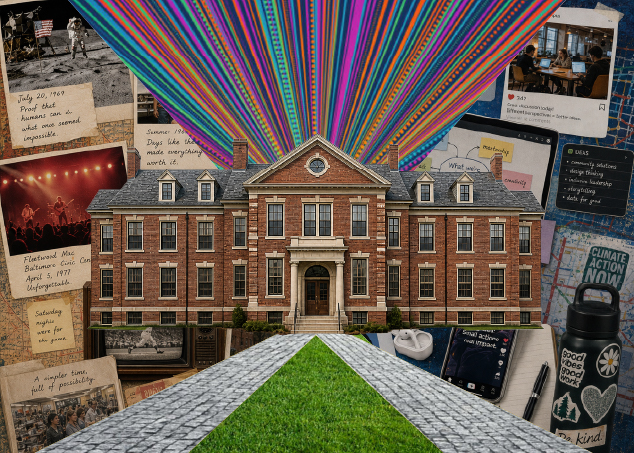 Christian Houck is a senior at Goucher College in Towson, Maryland, planning to graduate this May. With a major in psychology and political science and a minor in sociology, and as president of the student government association, it makes sense that he’s enrolled in a “Life and Politics in Baltimore” course this semester. What’s surprising is that his favorite aspect of the class is the experience 88-year-old fellow student Patricia Blanchard brings to the table.
Houck and Blanchard are classmates, thanks to the Goucher University Retirement Community (URC), a year-old co-generational living and learning program that is the first of its kind in Maryland. Goucher’s URC reflects two intersecting forces: the need for more retirement communities, driven by the unprecedented number of Americans over 65 who want to remain socially and mentally engaged; and the decline in college enrollment, driven in part by plummeting birthrates that have resulted in the closure of hundreds of colleges in the past two decades.
At Goucher, a mutually beneficial arrangement appears to be forming, with the college gaining revenue, retirees gaining an intergenerational home, and the students gaining new perspectives from people who have decades of all kinds of experience. The partnership between Goucher and adjacent Edenwald Senior Living includes co-generational housing, study abroad programs and, for Edenwald’s 480 residents, access to Goucher’s library, dining hall, performing arts and community garden.
As its incoming student body shrinks — high school populations peaked in 2025 and now face a 13 percent decline over the next 15 years — Goucher is among the nearly 100 higher-ed institutions pairing older-adult housing with campus access, lifelong learning and intergenerational contact. While the first university-retirement communities emerged in the mid-1980s at Iowa State University, most of the ones that exist today began after 2000.
Goucher’s URC launched in 2025. So far, 40 to 50 Edenwald residents have participated in its campus activities. While some students and faculty have expressed concerns, Goucher leadership has argued that financial gains will help support existing and continuing undergraduate programs in a time of dropping enrollment.
Houck admits that when he and his fellow students first learned Edenwald residents would be auditing classes, there was some hesitation. “Would we lose class spots? Would there be culture clashes? I think all those fears have been assuaged by the care that went into the program,” he says.
Lifelong Learning, Sold Out
For more than 40 years, Goucher and Edenwald have been neighbors in the leafy community of Towson, 14 miles north of downtown Baltimore. Goucher President Kent Devereaux got the idea for teaming up with Edenwald after learning about a similar program at the University of Florida in Gainesville, where his retired mother- and father-in-law enrolled in classes a decade ago. When Devereaux became president of the college in 2019, he began thinking about a retirement community collaboration and reached out to Edenwald’s president and CEO, Mark Beggs, and found a willing partner.
“Goucher understands the vision of higher ed’s future and the value a senior population can bring,” says Beggs. “Senior living is changing dramatically, and there’s a portion that wants to be engaged in the intergenerational world around them.”
The college has leased three acres of its campus adjacent to the retirement community for future development. “We are leveraging Edenwald’s proximity to the school in a big way,” he says. “If successful, we’ll be able to do even more.”
Currently, Edenwald’s population skews older, with an average resident age of 84. With the construction of three new living towers on the land leased from Goucher, Edenwald is targeting younger retirees who will be attracted to the college’s offerings. Most will fall in their sixties and seventies and occupy larger apartments — the smallest will be 1,100 square feet, the largest 2,300. As a “life plan community” offering independent living through advanced nursing care, Edenwald’s entrance fee will run between $480,000 to $1.4 million, plus monthly service fees that include access to Goucher classes and amenities.
Edenwald opened a priority deposit list last July, and sold out the entire expansion (125 apartments) by early January. Residents who made their 10 percent deposits will begin moving in by late 2028, and Beggs expects full occupancy of all towers by 2030.
Edenwald residents like Blanchard — who is a Goucher alumna — have already begun taking advantage of the partnership. “As soon as they introduced it, I researched programs like this around the country,” says Blanchard. “I’m a big believer in keeping the brain moving.”
Last spring, Blanchard enrolled in a specially designed co-generational class focused on the history of food and nutrition, led by an anthropologist. “It was an exceptional course,” she says. “We worked in small groups, which allowed me to get to know the young students.”
This semester, Blanchard has studied alongside her undergraduate friend Houck, who says the learning goes both ways. “You have someone teaching the class with local governmental experience, but Miss Pat lived it and can shine a personal light on various events,” he says. “I greatly appreciate that she can name names and talk about how practices have evolved over time.”
Devereaux says that the Goucher URC is a model that could scale at other liberal arts colleges, especially those with a “Goldilocks” location like Goucher’s, just outside Baltimore. “Residents can easily get downtown for the symphony, museums and sporting events, and we have a stable, 100-plus-year-old nonprofit as a partner,” he says.
But Devereaux notes that having a strong partner is essential. “You have to be very intentional about forming a partnership,” he says. “This should be an arrangement that can transform your school in very positive ways, across the board.”
Amanda Loudin is a Maryland-based freelance writer who covers health, science and higher education, among other topics.
KEEP READING
FIVE QUESTIONS
Michael Clinton on “Life Layering”
ALT/SHIFT
She’s 88. He’s 21. They’re Classmates
FINANCING LONGER LIVES
How to Balance Love and Money Decisions
DEEP DIVE
Betting on the Longevity Market
How Leading Brands Are Winning the 50+ Economy
GRANDPEOPLE
Meet the King of Big Veg
GAME CHANGER
Incarcerated as a Teen, He’s Now a CEO
LONGEVITY LITERACY
The Longevity Dividend
@SCL:
2026 Design Challenge Winners
Chip Conley on “Transitional Intelligence”
On the Air With SCL Experts
RELATED ARTICLES

From Sprint to Marathon: Mapping Four Quarters of the 100-Year Life

Cumulative Social Advantage