
LONGEVITY LITERACY
Compression of Morbidity
By Esther Landhuis
A theory that medical advances can allow people to lead longer, healthier lives faces a sobering test, especially in the U.S.
 A fictional horse carriage in an 1858 poem by Oliver Wendell Holmes “was built in such a logical way,” with no component failing before the rest, that the “one-hoss-shay” ran 100 years before suddenly collapsing.
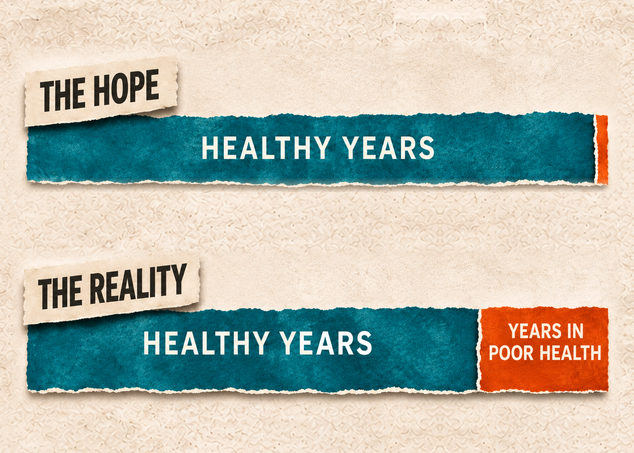
This image resurfaced as Stanford physician James Fries pondered the rise in human life expectancy during the 20th century. In a 1980 article in The New England Journal of Medicine, Fries made a bold claim: As medical advances compress illness into shorter windows near the end of life, people could live more like the imagined carriage, enjoying many years in old age before a fast death.
Known in academic circles as compression of morbidity, the idea, put less arcanely, is to “die young, as late as possible,” says Simon Hay, an epidemiologist at the University of Washington’s Institute for Health Metrics and Evaluation (IHME). Though he’d vaguely heard the concept, it wasn’t until Hay read Fries’ original 1980 paper cover-to-cover on a Friday night that he decided to challenge the concept.
Testing Fries’ hypothesis isn’t straightforward. While lifespan is concretely measured in years, there isn’t a singular metric for healthspan — a measure of the quality of life, i.e., years without significant disease, pain or disability.
Various criteria address healthspan, but nuances can create a murky picture. For example, in an analysis of coronary heart disease in Rochester, Minnesota, between 1950 and 1975, the percentage of hospitalizations for heart attacks in people over 65 went up despite declines in the number of people having or dying from heart attacks. In other words, people were having more heart attacks and surviving, yet spent their subsequent years in compromised health.
A more comprehensive analysis led by University of Southern California gerontologist Eileen Crimmins looked at changes in disabled life expectancy and disability-free life expectancy in U.S. adults between 1970 and 2010. Core data came from U.S. Vital Statistics reports, which track many leading causes of death, including chronic disease, infections and external factors such as accidents and suicides. That research, published in 2016, found that lifespan and healthspan largely remained in tandem, says Crimmins. “Basically there’s no real improvement in either the proportion or in the time spent with some sort of morbidity.”
Last year, Hay’s team published the latest Global Burden of Disease report — a giant dataset from which they estimated how long people live, and how long they live in good health, in 204 countries and territories from 1990 to 2023. Findings from this largest analysis of compression of morbidity to date were published in August in The Lancet Public Health. The upshot: While average lifespan around the world increased roughly nine years between 1990 and 2023, only about seven of those extra years are spent in good health. “We are living longer, but we aren’t compressing illness; we’re stretching it,” Hay says.
And the extra years of poor health don’t just come in life’s final chapter. “They’re spread across adult life — bad backs in midlife, depression and anxiety, hearing loss, and falls — deeply unglamorous conditions that rarely kill anyone but quietly eat up years of life,” Hay says.
Another sobering surprise: Among the countries studied, the U.S. has the largest lifespan-healthspan gap (14 years), and Americans spend nearly 18 percent of their lives in poor health — a larger share than in almost any other country, Hay says. “That is a sobering number for the country that spends more on healthcare than any other.” While the study did not specifically project future costs, it suggests that continued expansion of morbidity will put greater pressure not only on healthcare systems but also on labor markets and long-term care.
Rather than counting lives saved, Crimmins notes, the findings suggest that healthcare systems should focus less on symptom management and more on prevention, to thwart the conditions that cause people to be disabled or unable to function.
KEEP READING
FIVE QUESTIONS
Jaimie Krems on the Power of Friendships
FINANCING LONGER LIVES
Gen X is Turning 60 – It’s Not Pretty
DEEP DIVE
Life Expectancy Is Falling for the “Forgotten Middle”
THE LONG GAME
Meet Jonathan, the 194-Year-Old Tortoise with Surprisingly Youthful DNA
ALT/SHIFT
Psychedelics May Benefit Aging Brain Health
LONGEVITY LITERACY
@SCL:
Enjoying SCL Magazine?
Esther Landhuis is an award-winning San Francisco Bay Area freelance writer with a PhD in immunology; she covers biomedicine in all dimensions.
RELATED ARTICLES
 Life Expectancy Is Falling for the “Forgotten Middle”
Reversing the rate of premature deaths among lower-middle-income Americans in their fifties takes new approaches to employment, housing and social connection.
Read more
 Sightlines Project Reveals Paradoxical Pattern in Americans’ Health Behaviors
Read more
 David Rehkopf on the Longevity Class Divide
SCL’s incoming director has developed a powerful combination of biology, data science and sociology to improve population health.
Read more
 The Longevity Dividend
The economic benefits of making longer lives as healthy and productive as possible are considerable.
Read more