
FROMTHE EDITOR
 The story of longevity is by and large about people living longer than ever before. But there is another story, less told and understood, about the intersection of wealth, health and lifespans. Residents of the poorest U.S. counties have life expectancies of 66 years, an average comparable to Afghanistan, Sudan and Rwanda, while those in the wealthiest counties live on average more than 80 years, closer to Japan, South Korea and Monaco.
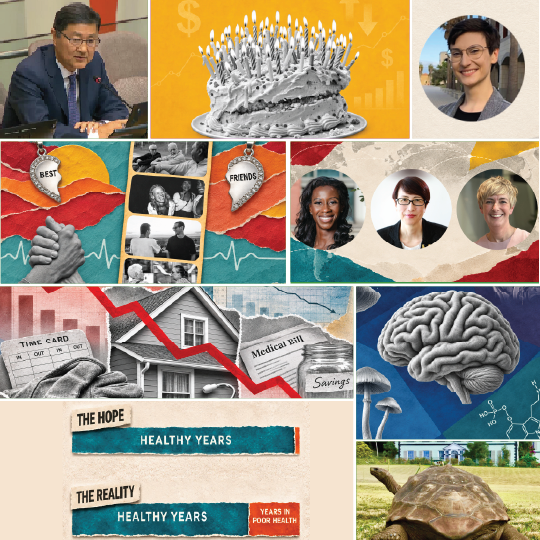
As Tamara Straus reports in our Deep Dive, researchers at the Stanford Center on Longevity led by director David Rehkopf, Stanford professor of epidemiology, medicine and sociology, are uncovering other stark disparities. Analyzing U.S. census data on more than 5 million people, they have identified a population whose lifespans have been declining for the past 20 years. Dubbed the “forgotten middle,” these are Americans between the ages of 50 and 59 who earn $30,000 to $75,000 a year, too much to qualify for public assistance yet too little to pay for life’s necessities. In midlife, their chronic financial stress manifests as illness and disability. The cumulative impact on society amounts to 314 million missing years of life, almost a year for every American, by Rehkopf’s calculation. Figuring out how to close those gaps is at the heart of SCL’s work, and Tamara reports on meaningful efforts in that direction.
In Alt/Shift, Julie Gordon writes about early-stage research into psychedelics such as psilocybin, which have shown promise in addressing PTSD and depression. Now, this subclass of mind-altering substances that primarily interact with serotonin receptors in the brain might also help improve neural plasticity — the brain’s ability to form new neural connections — which typically declines with age.
In Financing Longer Lives, MP Dunleavey writes about reality biting Gen X yet again, as its oldest members turn 60. MP finds that the generation labeled “slackers” as they came of age in the 1990s were in fact guinea pigs: the first U.S. workers expected to fund their own retirements through 401(k)s and other employer-sponsored savings plans rather than through pensions, with markets tanking during their wealth-building years. MP outlines a five-part financial plan to help a beleaguered generation recover lost ground.
In our fun new feature the Long Game, you’ll meet a British veterinarian on the remote South Atlantic island of St. Helena who tends Jonathan the Giant Tortoise, believed to be the world’s oldest living terrestrial creature. At 194, Jonathan not only has an active love life, but his DNA may hold clues for cancer resistance and healthy aging in humans.
I hope you will enjoy Richard Eisenberg’s Five Questions with Jaimie Krems of the UCLA Center for Friendship Research, who says, “If friendship was a drug, it might be one of the most prescribed medications in history.” As Thanksgiving approaches, we wish you a big helping of this life-extending delight with all the sides and we are thankful to have you as our readers.
We are delighted to announce our new content partnership with the business intelligence platform ROAR forward. We look forward to bringing you fresh perspectives, new coverage areas and news about additional media partners in the new year. In the meantime, we wish you a healthy, happy holiday season!
Karen Breslau
Editor
KEEP READING
FIVE QUESTIONS
Jaimie Krems on the Power of Friendships
FINANCING LONGER LIVES
Gen X is Turning 60 – It’s Not Pretty
DEEP DIVE
Life Expectancy Is Falling for the “Forgotten Middle”
THE LONG GAME
Meet Jonathan, the 194-Year-Old Tortoise with Surprisingly Youthful DNA
ALT/SHIFT
Psychedelics May Benefit Aging Brain Health
LONGEVITY LITERACY
@SCL:
Enjoying SCL Magazine?