
FIVE QUESTIONS
Andrew Scott on Baby Busts and Growth Booms
By Tamara Straus
New research finds that lower birth rates have not reduced GDP.
Andrew Scott is a rare voice in the wilderness of analysts not yelling “demographic doom!” A professor of economics at the London Business School and principal scientist for economics at the Ellison Institute of Technology Oxford, Scott argues that contrary to popular belief, aging societies do not have to experience economic decline. “If we keep people healthier for longer, we get a different outcome. If we keep them skilled for longer, we get a different outcome. If we make work easier for them, we get a different outcome,” says the author of The 100-Year Life and The Longevity Imperative.
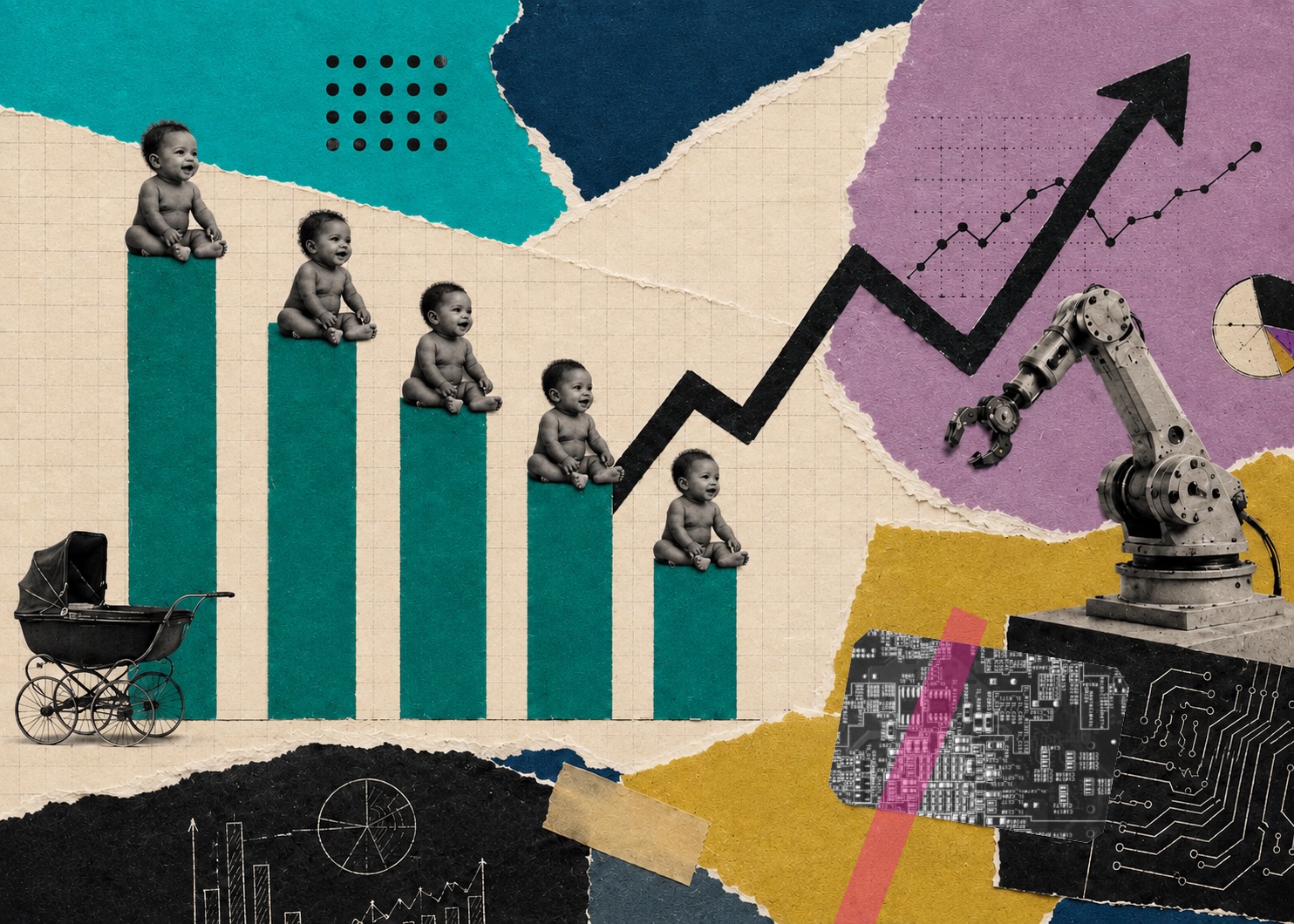
In a recent National Bureau of Economic Research working paper, “Baby Busts and Growth Booms: Demographic Change and the Macroeconomy,” Scott and his coauthors, Daron Acemoglu, David Autor and Keelan Beirne of MIT, analyzed 70 years of demographic data to assess the impact of aging and declining populations on economic performance across countries and within the United States. The paper digs a hole in the dominant narrative that declining birth rates negatively shape labor markets and slow the economy. The authors find that lower birth rates — and the aging and shrinking populations that result — have actually raised, not lowered GDP per working-age adult from 1970 to 2020.
These effects cannot be explained by education, increased female labor-force participation or the declining role of agriculture. Rather, they reflect a labor-saving technological response to the scarcity of younger workers with things like computer software and automation. Also, the paper shows that countries and regions with lower birth rates produce more labor-saving patents and have greater high-tech activity and higher productivity.
This interview has been edited for length and clarity.
What are the most surprising findings of your latest research?
I was surprised by the magnitude of the effect. If you go through the paper, the GDP per employed worker effect is interesting, but the fact that there was no effect on overall GDP was particularly striking. That’s counter to quite a lot of work.
What impact might your research have on governments as they grapple with aging workforces and increasing social welfare costs?
Countries that have rapidly aging societies focus on the fall in birth rates, not longevity and the rising number of older people. The punch line of this paper is that across countries and U.S. commuting zones [an economic term for geographic clusters of counties grouped by worker commuting patterns], you don’t see aging regions having worse economic performance. In fact, you see a rise in income per head, and that compensates for having fewer heads. So GDP growth remains unchanged.
I’m hoping these findings have an impact on ministries of finance and central banks. One is to stop all the doom-and-gloom stories that say, “There’s nothing we can do about it. Social Security is going bankrupt. We’re going to have to raise taxes, or we’re going to have to cut pensions.” As an economist, I’m interested in how systems adapt to shocks. We now have a 50 percent chance of making it to 90. So we need to invest in our education, our health, our relationships. We need to create institutions to support human capital in the second half of life. I want ministries of finance to say, “OK, demography is not destiny. What policies, what adaptations, what adjustments do we need?”
How might China’s future, in terms of demographics and economic growth, differ from the United States?
China is going to have a fall in birth rates much greater and further than anything we’ve seen in the last 70 years. I’m sure there will be a technological response. I’m sure China will invest more in human capital in the second half of life. But it’s such a big fall in population that my hunch is the economy will be affected. In the U.S., the fertility rate is still expected to fall, but not by as much as in China, and the population is still growing.
It’s important to disentangle three things: One is having a higher proportion of older people, which is caused by a fall in the birth rate; the second is there being fewer people, which is what happens when you get population declines; and the third is people living longer, which means you get more old people. Those are three very different channels that are different across different countries, and I think that’s the really important thing to bear in mind macroeconomically about the future. There will be responses that mitigate some of the bad news. It could be technology. It could be policy changes. It could be individual actions.
How might AI as a labor-saving technology affect not just GDP but individual healthspan, especially at a time when some employers are cutting back on hiring and laying off workers as they adopt AI?
Let’s take San Francisco, where we have seen a big shift to labor-saving technology, a big increase in average income per head, but we have also seen a massive increase in inequality. Our paper says nothing about that. But if labor-saving technology brings about higher inequality, then you’ve got to worry about inclusiveness. What labor-saving technology should do is increase the productivity of workers, so on average they’re better off in terms of mental and physical health and job security.
Do you think the gloom and doom around demographic shifts will lessen?
I do think it’s going to crescendo. The U.S. is particularly keen on generational labels, which I find both interesting and unfortunate. What’s changed is that the young can now expect to become the old, which hasn’t been the case for much of human history. We’ve set up this zero-sum conflict game that is the very opposite of what we need from a longevity perspective. Older people have always tended to be wealthier than younger people, and if that carries on in the future, it’s OK. But if we are seeing a group who are particularly powerful or particularly rich, then we have a problem. But that’s not about boomers versus millennials.
KEEP READING
FIVE QUESTIONS
Andrew Scott on Baby Busts and Growth Booms
ALT/SHIFT
Making Time to Talk About Life’s End
DEEP DIVE
Rebuilding the On-Ramp to Adulthood
GRANDPEOPLE
The Traveling Nanas
GAME CHANGER
Lucy Marcil on Money as Medicine
FINANCING LONGER LIVES
What Aging Parents Want the “Kids” to Know
LONGEVITY LITERACY
Palliative Aesthetics
@SCL:
- Sightlines Project Reveals Paradoxical Pattern in Americans’ Health Behaviors
- Bernardo Mackenna: How Bodies “Tell the Story”
- Making Sense of Peptide Mania
Enjoying SCL Magazine?
Tamara Straus is deputy editor of SCL Magazine.
 The Longevity Dividend
The economic benefits of making longer lives as healthy and productive as possible are considerable.
Read more
 Laura Carstensen on Longevity’s Big Moment
The founding director of SCL reflects on the greatest challenges and opportunities of longer lives.
Read more
 The Future of Learning and Earning
Read more