FINANCING LONGER LIVES
Millennials Reach Key Milestones Later
By MP Dunleavey
College debt, recession, the pandemic and other challenges have made it tougher for this generation to build wealth.
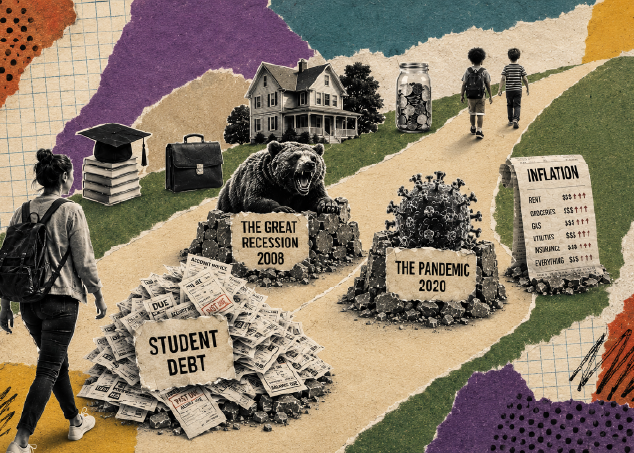 When Laura C. was in college, she intended to get a job, save money and enjoy the same kind of financial security her parents had while she was growing up.
“It didn’t turn out like that,” says the 42-year-old, who requested we not use her last name.
Like many millennials, the cohort born roughly between 1981 and 1996, Laura graduated from college in 2006 into a wobbly economy, which plunged into a global recession just two years later. “I didn’t have a grown-up job for a long time,” she says.
Getting her graduate degree in 2016 paid off in that Laura landed a full-time administrative job in New York City, where the salary was better and she was able to join the company’s pension plan. But the cost of living in the city was higher, and for years she was burdened by debt: “The loans from my master’s degree followed me for over 10 years. It was such a struggle.”
When Laura talks about her parents, who emigrated from Mexico to the U.S. and raised four children in the Midwest in the 1990s — running their own business, saving money and getting ahead (even building a retirement home for themselves in Mexico) — the contrast is stark: “I’m definitely making more than they were,” she says, “but I can barely save anything, and that’s without children.”
No generation is a monolith. But the economic headwinds most Americans have faced, from the dot-com bubble to the Great Recession to the pandemic, struck at particularly critical times for millennials like Laura. Many have reached their adult years without hitting the usual benchmarks of adulthood, raising questions about how they’ll navigate the twists and turns of longevity that older generations are struggling with now.
“Overall, this generation is entering one of the most financially complex life stages,” says Surya Kolluri, head of the TIAA Institute. “They’re navigating homeownership, student debt, inflation and even caregiving — all of which is playing out in their attitude toward retirement and longevity.”
A Series of Unfortunate Events
To grasp where many young adults stand today, it helps to look at the economic upheaval that millennials — who range in age from about 30 to 45 — have faced so far, as well as the unfortunate timing of those events.
Consider that millions of older millennials graduated from high school into the dot-com crash, which was followed by the devastation of 9/11 and the wars in Iraq and Afghanistan. Then, as they were graduating from college, the Great Recession of 2008-09 struck, upending economies worldwide.
Meanwhile younger millennials, now about 30, experienced similar shock waves when the Covid-19 pandemic overtook their post-college years. That has been followed by years of inflation and higher interest rates, which added to their cost of living.
In short: There have been major structural changes to the ladder leading to adulthood. Millennials were among the first to see college tuition skyrocket as they entered their high school and college years: The total price of attending a public, four-year institution has risen 68 percent since the 1999-2000 school year.
Another broken rung on the ladder: The rise of the gig economy has altered young adults’ expectations around jobs and careers, with 55 percent of millennials saying that gig work is their primary source of income, not full-time jobs.
No wonder it’s been hard for millennials to find their footing. They carry an average of $33,000 in student loan debt, a burden that’s grown worse for some in recent years, thanks to changes to loan repayment terms and higher interest rates. And many find it hard to afford a home, a vital step on the road to building long-term wealth: About 54 percent of Gen Xers have a mortgage, for example, while only 37 percent of millennials do.
These hurdles are concerning enough in the present — and they’re likely to hamper how this cohort thinks and plans for a future where longevity isn’t news anymore; it’s baked in.
A Spirit of Self-Reliance
In that sense, these years of economic setbacks may end up producing a silver lining. One of the intriguing findings of the TIAA report was that 81 percent of millennials anticipate funding their retirements with self-funded accounts like IRAs and 401(k)s — higher than other groups who put Social Security first.
“Unfortunately, I think this speaks to a certain lack of confidence in the future of Social Security,” Kolluri says. “Young people need to get past the negative press, so that they embrace Social Security as a part of their plan.”
On the flip side, it also reveals a certain can-do attitude, Kolluri notes. “They recognize that the equation has changed from their grandparents, who had pensions, to the defined contribution plans of today. So you’re seeing a greater sense of self-reliance.”
Laura would agree. She and her friends talk about money and retirement all the time, she says, and very much in the spirit of taking the reins themselves. “We’ve all been through enough hardship that money has always been at the front of our minds. It’s not like we have another option.
“Most people I know who are my age want the same goals people have wanted forever, like buying a house and providing the best possible financial situation for their families,” Laura adds. “It’s just happening more slowly.”
KEEP READING
FIVE QUESTIONS
Arielle Galinsky on Connecting “Olders and Youngers”
IN THE NEWS
David Rehkopf on the Longevity Class Divide
DEEP DIVE
Tackling the Family Caregiver Squeeze
GRANDPEOPLE
Bibliophile on Wheels
ALT/SHIFT
Hollywood’s Age Shift Is Underway
LONGEVITY LITERACY
Rejuvenation Science
GAME CHANGER
Daron “Farmer D” Joffe on Roots and Renewal
FINANCING LONGER LIVES
Millennials Reach Key Milestones Later
@SCL
Mauricio Lopez-Mendez: Charting Easier Paths for Dementia Patients
Colombia Court Cites Center’s Research
Summer Podcasts
Enjoying SCL Magazine?
MP Dunleavey is an award-winning journalist, columnist for SCL Magazine and a regular contributor to the Kiplinger Retirement Report.
RELATED ARTICLES

Retirement Income Gap Sparks Innovation

You Need a Financial Longevity Planner