ALT/SHIFT
Hollywood’s Age Shift Is Underway
By Joe Seldner
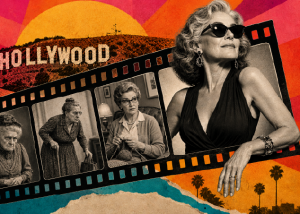
TV and film are finally giving older characters depth, agency — and an audience.
 A well-intentioned video produced in 2016 by AARP opens with an interviewer asking several millennials what age they consider “old.”
Their answers range from the late forties to fifties. A voice off-camera says, “Show me how an old person crosses the street.” The millennials shuffle their feet, lean on imaginary canes. “Now show me how an old person does a push-up.” At this implausible request, they grunt, buckle over. Enter some older people in workout clothes to perform physical exercises that seem to amaze the millennials. When they are asked again to define an age that’s old, their estimates shift: “Eighties to nineties?” “Maybe 100?”
I’ve been developing, writing and producing movies and TV for 40 years, with Tom Hanks, Billy Crystal and others, sometimes with great success, sometimes less so. My experience has given me a good idea of how to deliver a nuanced, compelling story. The AARP public service announcement missed the mark back in 2016 with these cartoonish portrayals of older and younger people alike, but the good news is that now people over 60 are becoming more visible and authentically portrayed in popular culture.
Part of that is due to demographics. With about 36 percent of Americans over the age of 50, that’s more than 120 million viewers looking for stories that reflect their lives. (AARP now even hosts “Movies for Grownups” Awards honoring 50+ talents.) The democratizing effects of streamers are also a factor, favoring creative experiments that major studios are often unwilling to risk.
Could it be that the era of older people in entertainment has arrived?
A case in point is Hulu’s Only Murders in the Building, starring Martin Short, 76, and Steve Martin, 80, and Selena Gomez, less than half their ages, as neighbors turn into sleuthing podcasters when their luxury Manhattan apartment building is stricken by a series of suspicious deaths. Although Gomez’s character does school her older costars in current culture, the gags are not directly about aging; rather, they feed the show’s comedy-mystery as it skips along with cameos from Mel Brooks, Meryl Streep and Shirley MacLaine. Launched in 2021, Only Murders became a quick hit with critics and audiences because of its great storyline and acting; the intergenerational cast only adds to the appeal.
The same is true for the 2024 Netflix series A Man on the Inside, starring Ted Danson as a retiree turned amateur private investigator with a much younger boss; HBO Max’s 2021 series Hacks, about a dark mentorship between a legendary Las Vegas comic played by 70-something Jean Smart and an entitled young comedy writer; and most recently The Boroughs, a star-studded Netflix drama about a retirement community beset by aliens.
Featuring Alfred Molina, Geena Davis, Clarke Peters, Bill Pullman, Denis O’Hare and Alfre Woodard — almost all in their seventies — The Boroughs is one of the best examples I’ve seen of countering age stereotypes with authenticity and credibility. Molina plays an introspective old man reluctant to consign himself to a retirement community; Davis convinces as an energetic former music manager romantically pursued by a handsome young security guard; Woodard plays a former journalist, and Peters charms as her marijuana-growing, spiritually minded husband, while O’Hare plays a retired doctor dealing defiantly with stage 4 prostate cancer. The sci-fi alien creatures that disrupt their retirement idyll is a bit over the top, yet it works because the interactions among the characters work.
The show was popular with viewers and critics alike, but was canceled by Netflix after only one season when the producers left for a four-year deal at Paramount, an object lesson in entertainment politics. Media reports indicate that “business” reasons led to the show’s demise, namely a clash of egos between the producers and executives. However, the willingness to cancel a hit series after one season may send an underlying message that it’s more acceptable to do so when the actors are of a certain age. That presents an opportunity to speak up and speak out and tell those in charge we want, need — and watch — these shows.
On the big screen, a growing number of movies feature older characters, including The Thursday Murder Club, The Last Showgirl, Weapons and Eleanor the Great (starring the marvelous 96-year-old June Squibb). These shows and movies feature older talent in front of and behind the camera, not just as afterthoughts and props, but as leading characters with complex lives, intricate, layered relationships and issues that have age-agnostic appeal.
Much of the casting for these series and films still features well-known names, which is understandable. Audiences tend to watch people they know: Jean Smart, Ted Danson, Geena Davis — all people with successful careers over 40-plus years. Michael Schur, creator of A Man on the Inside, told The New York Times he had worried about casting the show, but “discovered a wealth of talented older performers eager for substantive roles.” That makes sense since the median age of Screen Actors Guild members is now 42, according to SAG-AFTRA. Among those over 50, many are enormously talented yet not on the casting radar. A USC Annenberg study in 2017 found that only 9 percent of speaking characters on television were 65 or older. Anecdotal evidence suggests that percentage has increased.
Streaming Shifts Business and Cultural Paradigms
Changes in the entertainment business may be helping. The dominance of streaming, which relies on subscriptions rather than ad dollars, has made it easier for executives and producers to focus less on creating content primarily for younger audiences, who still get credit — incorrectly — for holding most of the purchasing power.
According to a recent report from AARP, adults 50 and older are a massive economic engine, generating $12.5 trillion in U.S. economic activity in 2024, and accounting for more than 53 percent of all consumer expenditures annually, including entertainment.
Yet economic power alone hasn’t been enough to shift the cultural paradigm.
Changing the narrative is also key. During the women’s and civil rights movements of the ’60s and ’70s, cultural influencers knew well that half the population was female and that there were tens of millions of people of color. Only when those voices coalesced into social and political movements did the decision-makers in film, television, advertising and other media change what they produced, and those populations began to see themselves in popular culture.
The popularity of The Boroughs, Hacks and other programs will make it more comfortable — and potentially more profitable — for decision-makers to finance and create programming with and for older people. And that will also appeal to younger generations, because realistic portrayals of multigenerational interactions have been shown to broaden rather than narrow audiences. Young people will likely continue to get more than their share of attention in the culture. But we older folks have wisdom, experience, resilience and, yes, beauty that isn’t always as easy to render on the screen or the page.
Popular culture moves in unpredictable ways, and often slowly. If, as the saying goes, “out of chaos comes opportunity,” the timing couldn’t be better. The consolidation of power in film, TV and journalism has happened before, but never with this much messy velocity, not to mention the disruptive impacts of streaming, artificial intelligence and social media. The leaders who take this opportunity to make older people a more consequential part of popular culture will reap rewards, financial and otherwise. And the best part is, it isn’t hard to do. The talent, and the audience, are eager to see more of themselves.
KEEP READING
FIVE QUESTIONS
Arielle Galinsky on Connecting “Olders and Youngers”
IN THE NEWS
David Rehkopf on the Longevity Class Divide
DEEP DIVE
Tackling the Family Caregiver Squeeze
GRANDPEOPLE
Bibliophile on Wheels
ALT/SHIFT
Hollywood’s Age Shift Is Underway
LONGEVITY LITERACY
Rejuvenation Science
GAME CHANGER
Daron “Farmer D” Joffe on Roots and Renewal
FINANCING LONGER LIVES
Millennials Reach Key Milestones Later
@SCL
Mauricio Lopez-Mendez: Charting Easier Paths for Dementia Patients
Colombia Court Cites Center’s Research
Summer Podcasts
Enjoying SCL Magazine?
Joe Seldner is a writer and producer, Pulitzer Prize-nominated journalist and 2022 Stanford Distinguished Careers Institute fellow who serves as an ambassador to the Stanford Center on Longevity.
RELATED ARTICLES

Dr. Ezekiel Emanuel Says Ignore the “Wellness Industrial Complex”

Why More Companies Are Recognizing the Benefits of Keeping Older Employees