
THE LONG GAME
Meet Jonathan, the 194-Year-Old Tortoise with Surprisingly Youthful DNA
By Tamara Straus
The world’s oldest known terrestrial animal is revealing clues about longevity, cancer resistance and the biology of aging.
Jonathan the giant tortoise was already past 50 when he arrived on the remote South Atlantic island of Saint Helena, a British Overseas Territory, in 1882. Queen Victoria was on the British throne. The automobile had yet to be invented.
Nearly 145 years later, Jonathan is still lumbering around his island home, enjoying his vegetables and occasionally pursuing female companionship.
Estimated to be 194 years old through DNA analysis, Jonathan may be considerably older, according to Jonathan Hollins, a British veterinarian who has cared for the 330-pound tortoise since 2009. “I’m quite convinced he’s probably over 200,” says Hollins. He and a team of scientists are intrigued by Jonathan not only because of his impressive age, but because his cells may hold clues to resisting some of the biological deterioration associated with aging.
Researchers at Vanderbilt, Cambridge and other universities have been studying Jonathan’s genetics and epigenetics — the chemical processes that help regulate which genes are switched on or off. Hollins likens the epigenome to a piano: the DNA provides the keys, but the epigenome determines which ones are played. As animals and humans age, these regulatory patterns become less orderly or damaged, a phenomenon researchers call DNA methylation entropy. Remarkably, Jonathan’s methylation entropy in regions of DNA associated with longevity resembles that of a 5-year-old tortoise. “That’s extraordinary,” says Hollins.
In a recent Science Advances paper, the researchers identified genetic variations, including additional copies of a gene in Jonathan’s DNA associated with eliminating both aging and potentially cancerous cells. Other pathways involving DNA repair, and cellular features associated with aging, telomeres and mitochondria, may help explain how giant tortoises maintain cellular health over exceptionally long lifespans. The findings are particularly interesting to cancer researchers because long-lived animals have more time to accumulate potentially dangerous cellular mutations.
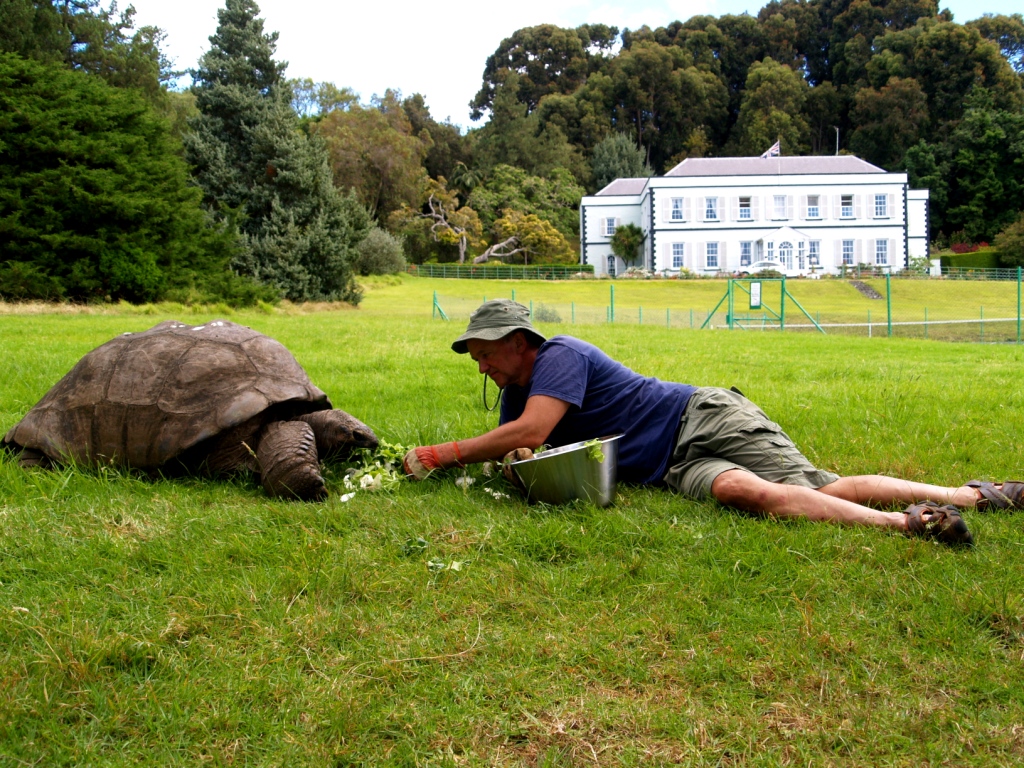
Jonathan with veterinarian Jonathan Hollins
Photo by Teeny Lucy
When Hollins became the first permanent vet on St. Helena in 2009, he recounts that the tortoise was in poor condition. He had cataracts, had lost his sense of smell, and was struggling to eat. “I just thought he’s very old. He’s probably going to die fairly soon,” Hollins recalls. Instead, Hollins improved his wellness regime with weekly hand-feedings of nutritious vegetables and fruit. Jonathan made an astonishing recovery.
“It was a sort of semi-miracle,” Hollins says. “His beak re-grew. He put on weight. He became more active, and he even recovered his libido with the female tortoise, which is a sign of inner health.” That last development wasn’t entirely without risk. Jonathan once toppled onto his back while attempting to mate and had to be rescued — a potentially fatal predicament for a tortoise.
Hollins believes Jonathan’s story illustrates the interplay between genetics, nutrition and environment. “We’ve always got that backpack of DNA,” he says. “Sometimes that’s a curse, not a blessing,” referring to genetic inheritance.
Hollins says Jonathan offers no secret to human immortality. But his extraordinary biology may help scientists better understand cancer resistance and healthy aging in humans. The veterinarian also has a more immediate ambition. “I want him to make his 200th birthday.”
KEEP READING
FIVE QUESTIONS
Jaimie Krems on the Power of Friendships
FINANCING LONGER LIVES
Gen X is Turning 60 – It’s Not Pretty
DEEP DIVE
Life Expectancy Is Falling for the “Forgotten Middle”
THE LONG GAME
Meet Jonathan, the 194-Year-Old Tortoise with Surprisingly Youthful DNA
ALT/SHIFT
Psychedelics May Benefit Aging Brain Health
LONGEVITY LITERACY
@SCL:
Enjoying SCL Magazine?
Tamara Straus is deputy editor of SCL Magazine.