
LONGEVITY LITERACY
Longevity Pyramid
By Esther Landhuis
A framework that organizes health and medical strategies from daily habits to experimental science.
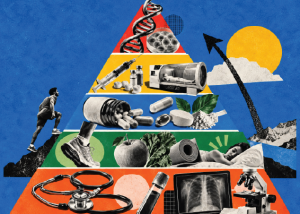
As a physician and academic who waded into the longevity space about a decade ago, Elisabeth Roider has balked at the false promises — single pills sold with claims that “you can live forever.” But the Zurich-based entrepreneur who holds physician-scientist faculty positions at Harvard University and the University of Basel firmly supports the core aim of longevity medicine: helping people to live longer, healthier lives, a concept known as “healthspan.” When she cofounded the Swiss longevity venture capital firm Maximon in 2022, the field was abuzz with new approaches such as stem cell and gene therapies and the Nobel Prize–winning gene-editing technology CRISPR.
It was clear to Roider that “if you eat 10 hamburgers a day, no CRISPR therapy can help you.”
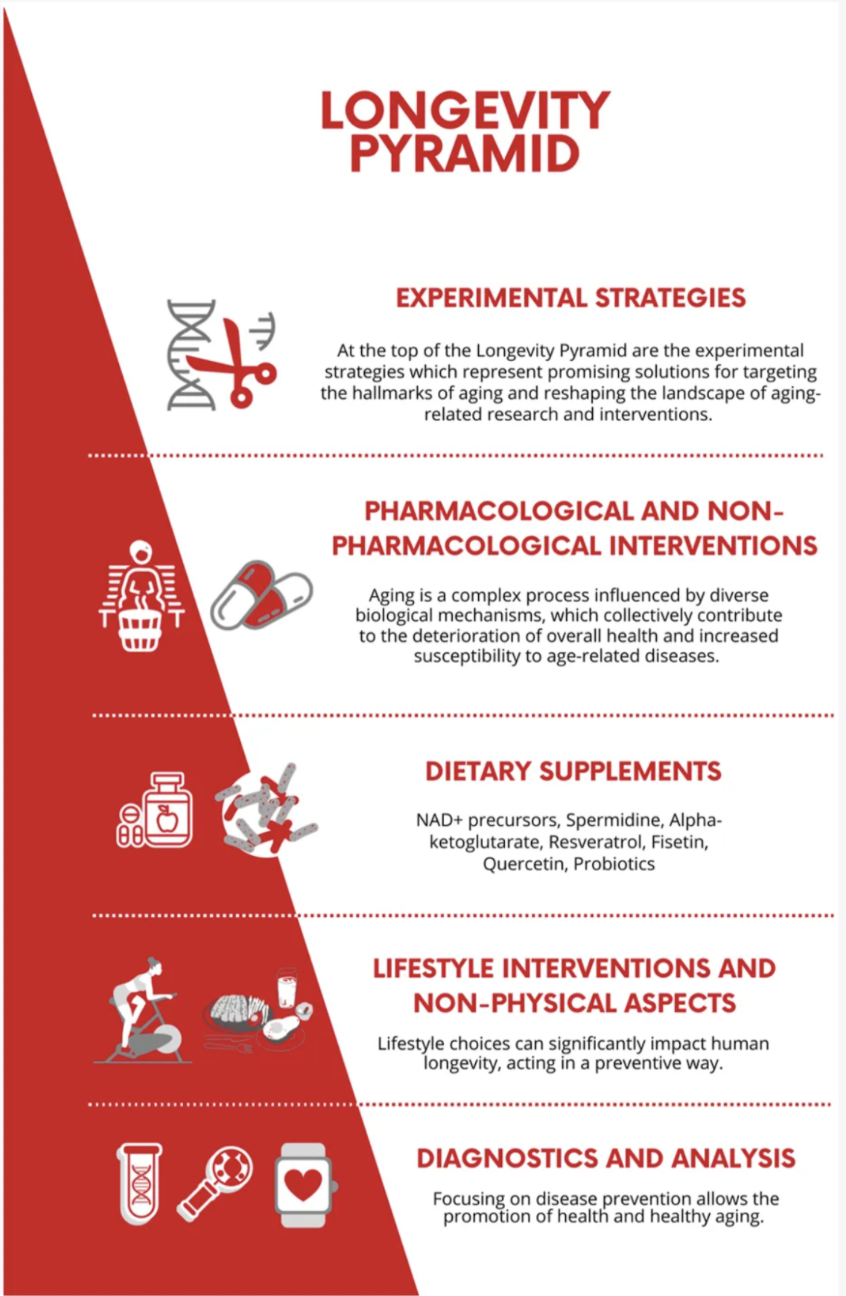
Enter the Longevity Pyramid — a framework Roider and several colleagues introduced in 2024 to provide a structured way to understand longevity medicine and underscore that cutting-edge innovations cannot work without a solid foundation of disease prevention and healthy habits such as good diet, exercise and sleep. “You really need to get the basics right,” Roider says.
Conceptually, longevity medicine can be framed as a shift toward prevention rather than crisis management. More than a century ago, when human life expectancy was much lower, physicians focused on acute care — prescribing medications for communicable diseases, for example.
Now staying healthy depends more on effective management of chronic conditions, largely today’s top four: cardiovascular disease, cancer, respiratory diseases and diabetes. Still, conventional medicine tends to operate with an approach historically used for infectious diseases, focusing on symptoms rather than early prevention — that is, treating the fraction of people who fall outside of the typical bell-curve distribution that defines a “normal” patient. Modern medicine also uses the evidence pyramid, which has the most reliable, rigorously tested research evidence as its top tier and, at the bottom level, experts’ opinions, anecdotal experiences and animal studies. The tiers in the evidence pyramid primarily indicate methodological quality — for example, how well a study was designed to minimize bias — rather than ranking the clinical utility of specific interventions.
Longevity medicine is fueled by a different paradigm. “Everybody gets old. Everybody gets gray hair. Everybody is losing muscle mass,” says Roider. These near-universal signs of aging emerge from underlying biological events that build up throughout the body, which she likens to a car that starts to break down more easily as the years go by. Longevity medicine aims to address these small issues — primary prevention on a cellular level, Roider says.
The Longevity Pyramid
Click to expand
The base of the pyramid consists of early-detection measures and diagnostics to identify potential health issues before they become a serious threat. The second-lowest tier involves lifestyle adjustments and health-promoting behaviors including diet, exercise, sleep and mental health.
Next up are dietary supplements, with a key caveat: Some have great evidence, others are nonsense, Roider says. Moving up the pyramid, the second-highest level includes FDA-approved pharmacological interventions such as GLP-1 drugs and metformin, used to regulate metabolism and blood sugar for weight loss.
Also on this level are relatively non-invasive interventions. One example, hyperbaric oxygen, involves breathing pure oxygen at high pressure to accelerate tissue healing. However, while the FDA has approved this approach for specific medical emergencies such as severe burns and hard-to-heal wounds, some clinics offer it as a treatment for various other conditions — including autism and age-related symptoms — without solid evidence of efficacy.
Sitting at the very top of the pyramid are experimental strategies — including stem-cell therapies, CRISPR and other approaches “that really change things in your body,” Roider says. Going up the pyramid, the measures get more complex, invasive and experimental.
KEEP READING
FIVE QUESTIONS
Elizabeth Coplan on Bringing Death to Life on Stage
FINANCING LONGER LIVES
What Do Generations Owe Each Other?
LONGEVITY LITERACY
DEEP DIVE
Our Households Changed. Our Neighborhoods Didn’t.
ALT/SHIFT
Aging-in-Place Renovation Boom
GAME CHANGER
Carlton Mason on the Power of an Intergenerational Village
@SCL:
Enjoying SCL Magazine?
Esther Landhuis is an award-winning San Francisco Bay Area freelance writer with a PhD in immunology; she covers biomedicine in all dimensions.
RELATED ARTICLES
 Rejuvenation Science
Rewinding the biological clock works for mice. For humans, not yet.
Read more
 Beyond DNA: How Your ‘Exposome’ Shapes Your Health
The exposome is the full range of environmental and social influences that accumulate across our lives—shaping health, opportunity, and longevity alongside our genes.
Read more
 How Much Health Data is Too Much?
For some users, the proliferation of continuous glucose monitors and other health devices can boost anxiety over wellness.
Read more
 The Longevity Dividend
The economic benefits of making longer lives as healthy and productive as possible are considerable.
Read more