
@ SCL
Bernardo Mackenna: How Bodies “Tell the Story”
New Map of Life fellow mines giant datasets to track human thriving.
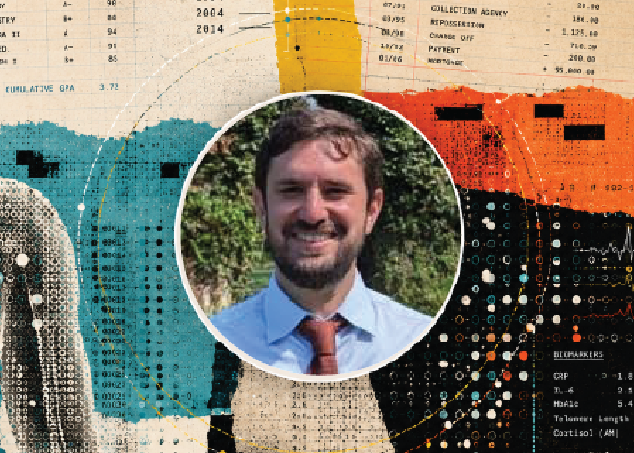
When sociologist and computational social scientist Bernardo Mackenna studies how people age, he starts when they are born.
“Things that happen to people across their lives have long-lasting effects,” he says. Childhood, adolescence, early adulthood and later life are not isolated chapters, he explains, but “a sequence of interconnected processes.”
That perspective brought Mackenna to Stanford’s Center on Longevity and the New Map of Life postdoctoral fellowship, where his interdisciplinary research — combining sociology, public health and computational methods — utilizes complex datasets to analyze how well or poorly people transition from one life stage to another. His aim is to inform “public-facing debates with policymakers, with industry partners” about what makes longer, healthier lives possible.
Mackenna, a native of Chile who received his PhD from UC San Diego, examines how the opportunities people encounter early in life ripple across decades. In one recent study, he and his coauthors examined why the overall U.S. trend of women surpassing men in earning bachelor’s degrees is not the case in many rural communities. The research showed that the social environments where young women grow up send powerful signals about what futures seem attainable, a concept known as “geographics of opportunity.”
In more conservative rural communities, young women may receive subtle messages that pursuing a four-year degree is not a path intended for them, despite the economic advantages it might offer. “It’s not just features of the economy,” Mackenna explains. “It’s also the social environment that is influencing the decision-making process in these pivotal points.”
Mackenna’s work aligns closely with two of the Stanford Center on Longevity’s signature efforts: the Futures Project on Life Transitions, led by SCL director David Rehkopf, professor of epidemiology and population health, which aims to quantify and understand barriers to thriving in American society; and the Learning Society Initiative, led by SCL co-director and education professor Mitchell Stevens, which advocates for access to lifelong learning opportunities as the key to economic advancement in an era of longer lives, rapid technological change and a volatile job market.
Mackenna’s current research amplifies these life-course approaches. As part of the multi-institutional EdShaRe project, he is part of a team analyzing one of the richest longitudinal datasets, following approximately 50,000 Americans from high school in the early 1970s and 1980s into their sixties and seventies. The project, which he calls “herculean,” combines educational records with financial data and health biomarkers to understand how experiences accumulate across four decades.
One paper from this data trove, “From Classroom to Classification,” finds that academic performance in high school predicts financial standing 40 years later — even after accounting for educational attainment, occupation and income.
Another preliminary study links personal financial histories with the blood and saliva biomarkers of participants. Mackenna and his collaborators have found evidence that chronic financial distress leaves measurable traces on the body itself.
“When you match these records and then you estimate their biological age,” he says, “you’re going to see that the people that have been more exposed to unpaid debt, to delinquencies, to foreclosures, to repossessions — their bodies tell that story.”
The research builds on the concept of “allostatic load” — the physiological wear-and-tear caused by prolonged stress. While healthy stress prepares the body to respond to challenges, chronic financial insecurity may keep the body in a prolonged state of alert, accelerating biological aging.
“I think the exciting part,” Mackenna says, “is the emphasis on thinking of aging as a multi-causal process.” Healthy aging, he argues, is shaped not only by diet and exercise but also by social and economic interactions that expose people to different conditions and opportunities across their lives.
Tamara Straus is deputy editor of SCL Magazine; she previously held senior editor positions at the Stanford Social Innovation Review and the San Francisco Chronicle.
KEEP READING
FIVE QUESTIONS
Andrew Scott on Baby Busts and Growth Booms
ALT/SHIFT
Making Time to Talk About Life’s End
DEEP DIVE
Rebuilding the On-Ramp to Adulthood
GRANDPEOPLE
The Traveling Nanas
GAME CHANGER
Lucy Marcil on Money as Medicine
FINANCING LONGER LIVES
What Aging Parents Want the “Kids” to Know
LONGEVITY LITERACY
Palliative Aesthetics
@SCL:
- Sightlines Project Reveals Paradoxical Pattern in Americans’ Health Behaviors
- Bernardo Mackenna: How Bodies “Tell the Story”
- Making Sense of Peptide Mania
Enjoying SCL Magazine?