
GAME CHANGER
Lucy Marcil on Money as Medicine
By Monique Brouillette
A Boston pediatrician helps low-income families care for health and finances together.
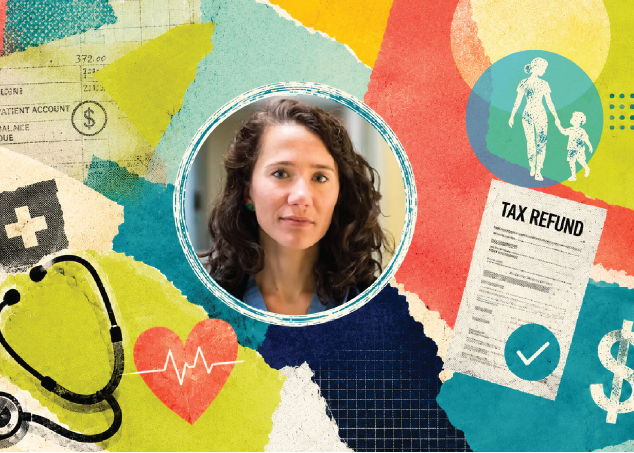
Lucy Marcil was a first-year pediatrics resident when a child showed up with asthma but no inhaler — the parent couldn’t afford to refill a prescription. She remembers another who came in talking about safety concerns in their neighborhood, and then others whose child’s behavioral issues at school were distressing. “I was seeing a lot of low-income families who kept coming back for health problems that were not necessarily of medical origin,” she recalls. “It was clear they were related to poverty.”
At first, Marcil’s solution was to tell patients about available resources. She recommended child support programs like the Earned Income Tax Credit, and pointed them to free tax preparation sites around Boston. Marcil knew that one in five eligible families don’t take advantage of the EITC, a refund program for low-income taxpayers. Many parents were simply unaware that they could be entitled to thousands of dollars — enough to fill those prescriptions.
One mother took her advice, traveling across town on multiple buses and trains only to find the tax prep office closed by the time she arrived. On her next visit, she was missing a document. She got frustrated, and at her next visit with Marcil said, “I have to come here all the time with these kids. Why can’t you do my taxes here?”
So Marcil, whose own childhood was marked by financial strain, set out to meet her patient’s request. Then a pediatrics resident and teaching fellow at Boston Medical Center and Boston Children’s Hospital, she decided in 2015 to create a free tax-preparation service and to embed it in the center’s pediatrics department, where roughly three-quarters of patients are low-income.
First, Marcil had to get licensed as a tax preparer. She convinced the department chair, Bob Vinci, to do the same. Together, they managed to get approval from Boston Medical to fund the program and break through the red tape, no small task at the largest safety-net hospital in New England.
They named the program StreetCred, a play on Earned Income Tax Credit, and in 2016, Boston Medical Center launched one of the first medical-financial partnerships in the U.S. The American Academy of Pediatrics recommends a minimum of seven well-baby checks in a child’s first year, so Marcil and her colleague Dr. Michael Hole designed StreetCred around the pediatric care schedule, taking advantage of the frequency of visits. Community health workers were stationed in the waiting room, where they offered to help parents and family members find tax savings they were eligible for.
Marcil still remembers her first client, a great-grandmother with custody of a 2-year-old. The woman was thrilled to receive a $3,000 tax refund and was so excited to use the money for “luxuries,” as she put it — a warm winter coat and fresh fruits and vegetables. “It’s shattering to think that in Boston those things are luxuries,” Marcil says. “But it shows you what a health intervention this is; getting people money is just as powerful as getting them medicine.”
Lifelong Benefits of Reducing Poverty
StreetCred soon expanded its offerings to include an “economic bundle” of seven federal and state resources that most low-income families with young children qualify for, but often aren’t aware of. These have included access to the Women, Infants, and Children (WIC) Program, Supplemental Nutrition Assistance Program (SNAP), a 529 College Savings Plan or a 530A investment account seeded with $1,000, Boston Medical Center’s food pantry, and tax-filing services.
Over the past three years StreetCred has served about 1,700 families and estimates it has helped families apply for about $7 million in tax refunds and credits through enrollment in their economic bundle. Marcil and her colleagues have also helped medical colleagues around the country set up similar programs, such as Tax Haven at Yale. The Health by Wealth Collective currently has 45 members in 15 states and the District of Columbia, according to Marcil, and they have filed at least 20,000 tax returns and helped participants claim about $35 million collectively in refunds.
Marcil says the benefits of reducing poverty extend beyond the early years. Financial stability, good health and longevity are strongly correlated in the U.S., where the richest 1 percent of American men live 15 years longer than the poorest 1 percent. For women, the life expectancy gap is 10 years. And in Boston, the Public Health Commission recorded an even more dramatic gap. Life expectancy in the tree-lined, brownstone-studded streets of the affluent Back Bay neighborhood is 92 years, but 2 miles away in Roxbury, the neighborhood with the highest proportion of families making under $15,000 a year, it plummets to 69 years, according to the commission’s Boston Community Health Needs Assessment in 2025.
“Longevity starts at birth,” Marcil says. “You don’t just die at 50 or 90. It’s an accumulation of life experiences.”
Financial interventions such as those offered by StreetCred have shown distinct health impacts. In 2014, researchers published findings from a statewide experiment in Oklahoma that automatically opened 529 accounts for newborns with an initial deposit of $1,000. Four years later, the mothers of children with savings reported measurably fewer depressive symptoms. The effect was evident across all income classes but was larger in low-income groups.
Marcil says witnessing StreetCred’s results has been rewarding. One mother of a 15-month-old told her she wanted to return to work but couldn’t afford childcare. After meeting with one of the community health workers at a well-child checkup, she found out she was eligible for a pandemic-era tax credit. The extra funds allowed her to pay for childcare and return to the workforce. “That’s what everyone in this country wants,” Marcil says. “To be able to provide for your kids and provide for yourself. So that’s what we do.”
KEEP READING
FIVE QUESTIONS
Andrew Scott on Baby Busts and Growth Booms
ALT/SHIFT
Making Time to Talk About Life’s End
DEEP DIVE
Rebuilding the On-Ramp to Adulthood
GRANDPEOPLE
The Traveling Nanas
GAME CHANGER
Lucy Marcil on Money as Medicine
FINANCING LONGER LIVES
What Aging Parents Want the “Kids” to Know
LONGEVITY LITERACY
Palliative Aesthetics
@SCL:
- Sightlines Project Reveals Paradoxical Pattern in Americans’ Health Behaviors
- Bernardo Mackenna: How Bodies “Tell the Story”
- Making Sense of Peptide Mania
Enjoying SCL Magazine?
Monique Brouillette is a freelance science journalist based in Cambridge, Massachusetts, who covers biomedicine and the life sciences.
 Cumulative Social Advantage
New research shows how connections affect aging at the cellular level.
Read more
 Beyond DNA: How Your ‘Exposome’ Shapes Your Health
Read more
 Tackling the Family Caregiver Squeeze
Some states and employers are making efforts to reduce the financial penalties that come with looking after an older relative.
Read more
 Millennials Reach Key Milestones Later
College debt, recession, the pandemic and other challenges have made it tougher for this generation to build wealth.
Read more