
LONGEVITY LITERACY
Palliative Aesthetics
By Laura M. Holson
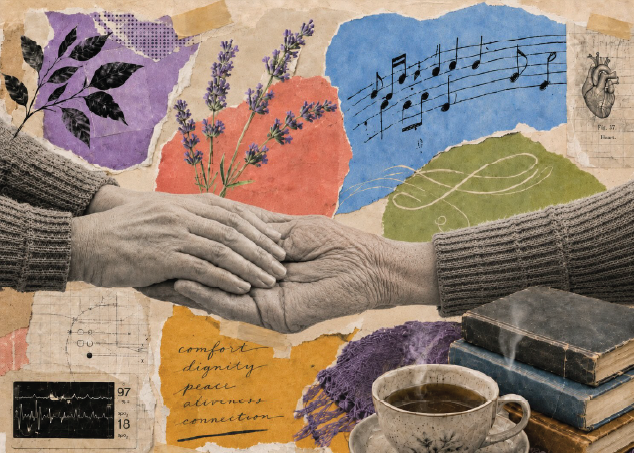
Palliative Aesthetics adj. noun: A therapeutic approach that summons art, design and beauty to relieve suffering and improve quality of life for patients facing serious or terminal illness. The concept shifts end-of-life care from a purely clinical intervention to a more holistic, sensory-based approach to death and dying.
According to BJ Miller, a palliative medicine physician and coauthor of A Beginner’s Guide to the End, the medical world has “gotten out of step with what it means to be a human being and what human patients want from their clinicians.” Miller says clinical evidence supports the effectiveness of sensory interventions in providing comfort for seriously ill patients, their families and caretakers. For example, music and access to nature offer a life-affirming alternative to the bland food, harsh lighting and constant hum of monitors common in modern healthcare settings. “Aesthetics has the capacity not only to diminish suffering but to actively augment aliveness, thereby expanding the impact of palliative medicine and making good on its promise to realize quality of life,” Miller and coauthors Johanna Glaser and Justin Burke wrote in a medical textbook about the practice.
Blending philosophy, sensory perception — and medicine
Aesthetic therapy as an aspect of medical care has been acknowledged for centuries, the authors wrote. The Sanctuary of Asklepios at Epidaurus was one of the earliest known sanatoriums, a healing complex in ancient Greece that contained a hospital, theater, libraries, sacred fountains and public baths.
The word “aesthetic” was defined by the 18th-century German philosopher Alexander Gottlieb Baumgarten to mean all that is perceived by the senses, unlike today’s narrow definition of what is visually pleasing. In 1790, Immanuel Kant argued that aesthetic experiences were valuable in and of themselves. These concepts were later applied in patient care.
Florence Nightingale, for one, a pioneer in the field of patient management, wrote in her 1859 book, Notes on Nursing, that patients benefited from fresh air, flowers and the absence of extraneous noise.
In the 1930s, John Dewey, an American psychologist and educator, wrote in Art as Experience that any satisfying activity that intensified a feeling of aliveness could be considered aesthetic. At about the same time, another American philosopher, Monroe Beardsley, described aesthetic experience as providing an opportunity for the integration of the whole person, which included self-acceptance and growth.
Later, St. Christopher’s Hospice in London, established in 1967 by Cicely Saunders, was designed with the comforts of home in mind, including natural light and foliage.
How is palliative aesthetics practiced today?
Palliative aesthetics is a counterpoint to the stress patients can experience when medical professionals are too busy or ill-equipped to deal with the physical and psychological complexities of dying. Clinicians have found that sensory therapies that address sight, sound and smell can provide comfort, reduce anxiety and promote a feeling of well-being among cancer patients. These therapies, too, can be a catalyst for wonder or awe, Miller and his coauthors write. At the same time, palliative aesthetics can help patients retain personal dignity in the face of physical decline by encouraging grooming, wearing favorite clothes and eating familiar foods.
A March 2026 review of literature found that “broader adoption of aesthetic interventions in palliative care required evidence-based guidelines, professional training and institutional support.” Within a holistic framework, the review said, practices including skin care, therapeutic touch and aromatherapy that aim to restore comfort and self-esteem have “begun to emerge as a complementary practice that aligns with the goals of palliative care.”
Laura M. Holson is an award-winning writer and founder of The Box Sessions. She worked at The New York Times for more than 25 years, receiving a National Magazine Award for public service reporting.
KEEP READING
FIVE QUESTIONS
Andrew Scott on Baby Busts and Growth Booms
ALT/SHIFT
Making Time to Talk About Life’s End
DEEP DIVE
Rebuilding the On-Ramp to Adulthood
GRANDPEOPLE
The Traveling Nanas
GAME CHANGER
Lucy Marcil on Money as Medicine
FINANCING LONGER LIVES
What Aging Parents Want the “Kids” to Know
LONGEVITY LITERACY
Palliative Aesthetics
@SCL:
- Sightlines Project Reveals Paradoxical Pattern in Americans’ Health Behaviors
- Bernardo Mackenna: How Bodies “Tell the Story”
- Making Sense of Peptide Mania
Enjoying SCL Magazine?
 Why the “Good Death” Is Having Its Moment
Death doulas, death cafés and candid conversations are reshaping how we face life’s end.
Read more
 Being Mortal: Medicine’s Most Vital Lesson?
A novel Stanford course teaches students how understanding life’s limits can help them become better doctors.
Read more
 Making Time to Talk About Life’s End
“It’s always too soon until it’s too late,” says the founder of the Conversation Project.
Read more