GAME CHANGER
Daron “Farmer D” Joffe on Roots and Renewal
By Stacey Freed
How a “turkey sandwich moment” led to a life connecting people with the soil — and each other.
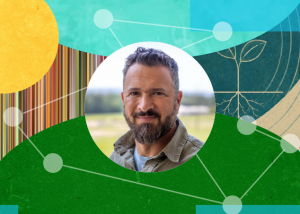 When Daron “Farmer D” Joffe talks about soil, he’s really talking about time — the slow, patient work of building something that outlasts any single generation. His 2012 book, Citizen Farmers: The Biodynamic Way to Grow Healthy Food, Build Thriving Communities, and Give Back to the Earth, features a fist thrusting upward holding three beets plucked from the soil. It’s an image of inheritance as much as rebellion: something grown, tended and passed forward.
For Joffe, an advocate for connecting people with agriculture through his nonprofit, Citizen Farmers, that is the essential work — cultivating not only food but the conditions for communities to flourish across generations. Over the decades, Joffe has advised, consulted, designed and built farms for neighborhoods, schools, prisons, hotels, towns and master-planned communities known as “agrihoods,” which are designed around a farm, much as other developments are built around a golf course, hiking trails or a lake.
Residents have access to fresh produce, and the farm brings people together through education programs and sometimes by working the soil together. Many of the principles Joffe advocates for align with SCL’s New Map of Life initiative: designing cities and neighborhoods from a public health perspective “to create more walkability, healthier, safer communities, access to local food — thinking about broad health outcomes that communities can foster if they’re designed right.”
The quick access to fresh fruits, vegetables and herbs offers a nutrient boost, which can help residents improve their healthspan, says Jay Maddock, a professor and director for the Center for Health & Nature at Texas A&M University who in 2025 began a study of the health benefits of agrihoods, focusing on the residents of Indigo, an agrihood 30 miles from Houston. In addition to the known health benefits of fresh produce, Maddock’s study will also assess the impacts of community design on reducing loneliness, a major health risk factor. In Indigo, says Maddock, “people are purposely moving there because of the agrihood. They are saying they want to move into a community; they want to know their neighbors.”
Joffe’s views are rooted in his own family history. In 1979, when he was 3, his family immigrated to Atlanta from South Africa, carrying with them the memory of Eastern European Jewish agrarian life — the “shtetls where communities were connected to the land and each other around rituals and cultural celebrations. I was trying to reconnect with that.” Those ancestral rhythms “around food, around seasonal celebrations, and storytelling,” shaped Joffe’s belief that how people grow and share food is one of the most important legacies one generation can pass to the next.
An early insight for Joffe came when he was a student at the University of Wisconsin in the early 1990s, and had a “turkey sandwich moment” while he was eating lunch and he realized how disconnected he was from where his food came from. Joffe had been wondering what to do with his life when it struck him: “I wanted to learn how to grow a turkey sandwich from scratch. It was a silly epiphany, but it had a big impact on me.”
He began reading agrarian writers such as Wendell Berry and Gene Logsdon to understand why more people weren’t “having the conversation about the loss of family farms, the impact of our food mile — the distance that food travels, the carbon footprint — the reliance on fossil fuels, the heavy use of chemical fertilizers, pesticides and fungicides, the impact on our health.”
Joffe did more than read. He apprenticed, farmed, dropped out of college and bought land in southwest Wisconsin. He followed ideas and information where they led him. A food truck. A farm newsletter. A farmers’ market. A long drive that became a meditation on accessibility — asking himself, “How could we make food more accessible for people who can’t necessarily afford organic food at a farmers’ market?”
Underlying Joffe’s work, says Modern Elder Academy founder Chip Conley, who hired Joffe to design the regenerative farm and gardens at the organization’s Baja campus, is the idea that “the soil and the soul have a lot in common. They both can be regenerated almost symbiotically.” Conley cites former Notre Dame philosophy professor Tom Morris, who said that “the most important thing we can do as we get older is ‘to be good soil.’ That’s really at the heart of Farmer D’s point of view. How can the soil be a teacher, and how can we be a gardener? And in that relationship between the fertile teacher and the agency-filled gardener, how can we work together and be better off for it?”
In recent years, Joffe, now 50, has been helping farming families and landowners think through the future of their land — how to pass a farm to the next generation in a way that honors the family’s history, or, if they must sell, “not just sell to a data center, warehouse, or conventional subdivision,” he says, a transaction that, in his view, “could permanently sever the land’s agricultural legacy and the opportunity for it to continue nourishing future generations.
Joffe is designing agrihoods and agrivillages where development becomes a tool for conserving farmland and natural systems instead of replacing them, and the driving question isn’t only how many houses can fit on a piece of land, but what kind of community the residents of those houses will create over the next 50 years. “Longevity isn’t simply about living longer,” he says. “It’s about creating the conditions for life to flourish — for ourselves, for our children, for our communities, and for the land that sustains us.”
KEEP READING
FIVE QUESTIONS
Arielle Galinsky on Connecting “Olders and Youngers”
IN THE NEWS
David Rehkopf on the Longevity Class Divide
DEEP DIVE
Tackling the Family Caregiver Squeeze
GRANDPEOPLE
Bibliophile on Wheels
ALT/SHIFT
Hollywood’s Age Shift Is Underway
LONGEVITY LITERACY
Rejuvenation Science
GAME CHANGER
Daron “Farmer D” Joffe on Roots and Renewal
FINANCING LONGER LIVES
Millennials Reach Key Milestones Later
@SCL
Mauricio Lopez-Mendez: Charting Easier Paths for Dementia Patients
Colombia Court Cites Center’s Research
Summer Podcasts
Enjoying SCL Magazine?
Stacey Freed is a freelance writer based in Pittsford, N.Y. She is co-author of Hiking the Catskills and former vice president of the American Society of Journalists and Authors.
RELATED ARTICLES

Economic Mobility Is Intergenerational

Allison Pugh on the Bonds That Sustain Us