FIVE QUESTIONS
Bruce Feiler on Mastering Life Transitions at Any Age
By Richard Eisenberg
The author of Life Is in the Transitions shares key skills and tools for “lifequakes” and transition pileups.
 Bruce Feiler is fascinated by life transitions. That’s because he’s experienced plenty of them. The best-selling author of self-help books experienced a series of overwhelming crises — what he calls “lifequakes” — in his forties, including cancer, near bankruptcy and his father’s suicide attempts. Those trying times made Feiler realize how much of life is spent in upheaval, and how vital it is to develop tools to help navigate these disrupting periods, leading him to research how others successfully rebuild their lives and find new meaning.
The result is Life Is in the Transitions: Mastering Change at Any Age, which came from interviewing 255 Americans about their personal jolts. The 2020 book also became a bestseller and has led Feiler to create something of a life-transitions empire. There’s his 2.1 million–view TED Talk; a virtual TED course, “How to Master Life Transitions”; and Feiler’s new Substack newsletter on navigating life’s twists and turns, The Nonlinear Life. Recently, Stanford’s Computational Psychology and Well-Being Lab named Feiler a fellow and is working with him to build an AI model out of all his life-transition stories. Its goal: “to help identify when people might go into life transitions and navigate them,” says Feiler.
Feiler’s interviews also taught him that a well-balanced life has three ingredients, which he calls the ABCs of meaning. A is Agency — what we do, make, build or create; often that’s through work. B is Belonging — your relationships, family, colleagues and friends. C is a Cause — a calling, purpose or something higher than yourself.
This interview has been edited for length and clarity.
What made you interested in life transitions and surveying Americans about them?
I was in a life transition myself and didn’t have language for it or the concepts that would help me go through it more effectively. For the first 20 years of my adulthood, I had a classic linear life. I figured out what I wanted to do early and had some success. I got married. I had children. Then in my forties, my life blew up. I got cancer when we had 3-year-old identical twin daughters. Then I had financial trouble. Then my dad, who had Parkinson’s, got very depressed and tried to take his life six times in 12 weeks. I was a storyteller, but I didn’t know how to tell this story.
Then, I went around the country and said to people, “Tell me your story.” In the process of listening to 1,500 hours of interviews, I realized everybody had a similar story — something disrupted their lives.
You believe that life is nonlinear and we need to embrace that. What do you mean by a nonlinear life, and how can we embrace it?
The idea that we’re going to have one relationship, one job, one home from adolescence to assisted living is deader than it’s ever been. The linear life has been replaced by the nonlinear life, with many more disruptions. My data show we now go through a life disruptor every 12 to 18 months; that’s around three dozen over our lives.
You found that one in 10 life transitions is what you call a lifequake, which you say is disorienting and destabilizing. What is a lifequake?
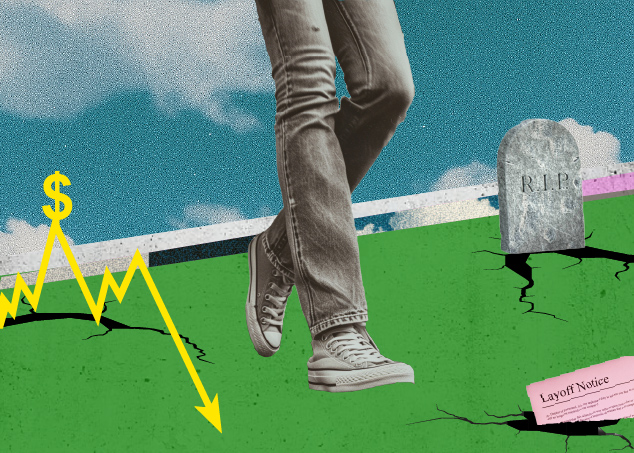
Unlike most life disruptors, a lifequake is a massive burst of change which leads to a period of pain and confusion — but can also, if handled properly, lead to a period of growth and renewal. The average length of a lifequake is five years, and we often have three, four or five in a lifetime. When people go through a lifequake, they tend to do one of two things. Either they make a to-do list and think that in one weekend they’re going to be the best ever or they go into a fetal position and say, “Woe is me. I’m never going to survive.” Neither one is true.
In my data, 57 percent of lifequakes are involuntary, like a downsizing, a diagnosis, a divorce, a natural disaster or a global pandemic. And 43 percent of lifequakes are voluntary. An example is when you decide to retire and choose to do something else.
In your interviews, how did you find people deal with life transitions, and how should they?
Any life transition is a skill with three phases:
- The Long Goodbye, which is about leaving the past behind.
- The Messy Middle, which is stumbling toward a fresh identity.
- The New Beginning, which is embracing the new you.
You need to realize which of those phases is your superpower and which is your kryptonite. If you’re very organized, you’re going to be good at the Messy Middle, because it involves shedding certain habits and experimenting. But your kryptonite may be the Long Goodbye, which is realizing you’re going through an emotional experience; you might have fear, sadness or shame. When you’re going through a life transition, whatever your superpower is, start there. Just remember: You’re going to have to go through the other phases and do the part that’s hard for you.
I found seven tools that people use to help with life transitions. They are:
- Accept It, by identifying your emotions.
- Mark It, with a ritual for the change.
- Shed It, by giving up old mindsets.
- Create It, by trying new creative things like picking up a ukulele or painting birdhouses.
- Share It, by seeking wisdom from others.
- Launch It, by unveiling your new self.
- Tell It, by reintroducing yourself to the new world.
How does mastering change differ as we get older, and what can we do to master change more effectively?
One advantage people with transitions have as they get older is that retirement is already self-identified in the culture as a transition. My research found that 60 percent of people move in a life transition, and it’s already normalized that people are going to relocate as they age. Another advantage when you’re older is that you should now be better at life transitions.
The more difficult thing as you get older is that your life transition can jostle your natural strengths and weaknesses. I interviewed a man who’d been an internationally famous pediatric physician with structure and purpose in his life. He retired and suddenly he’s not wearing scrubs or having that heroism. He’s realizing his family felt some resentment toward him because he was an absent parent or grandparent.
Also, in this stage of life, you may have multiple disruptors or lifequakes at once — that’s a pileup. You may not only be changing where you live and what you do, you’re going to start losing friends and loved ones and, inevitably, you’re going to have physical issues. A pileup makes things more complicated.
But the fundamental phases and toolkit for a life transition don’t change with aging. They’re exactly the same as at any time in your life.
Richard Eisenberg is an “unretired” journalist and podcaster specializing in longevity, work, money and retirement. He writes The View From Unretirement column for MarketWatch and is director of Digital Media Strategies at the NYU Summer Publishing Institute.
KEEP READING
FIVE QUESTIONS
Bruce Feiler on Mastering Life Transitions at Any Age
ALT/SHIFT
How Much Health Data is Too Much?
FINANCING LONGER LIVES
Retirement Income Gap Sparks Innovation
DEEP DIVE
Why More Companies Are Recognizing the Benefits of Keeping Older Employees
GRANDPEOPLE
Soufflé Chef Takes her Final Bow at 90
FROM THE EDITOR
LONGEVITY LITERACY
Multiomics
GAME CHANGER
An Ultrasound Helmet to Cleanse the Brain
@SCL:
SCL at World Economic Forum
Call for Case Study Submissions
Longevity Design Challenge Finals
Tell us about your “lifequake.”
What happened? What did you learn? How are you different now than before your lifequake? Send your stories to [email protected]. We will contact you if your story is selected for publication.