FIVE QUESTIONS
Michael Clinton on “Life Layering”
By Richard Eisenberg
“There’s a lot of 20th-century thinking that still exists in a 21st-century world,” says the author of Longevity Nation
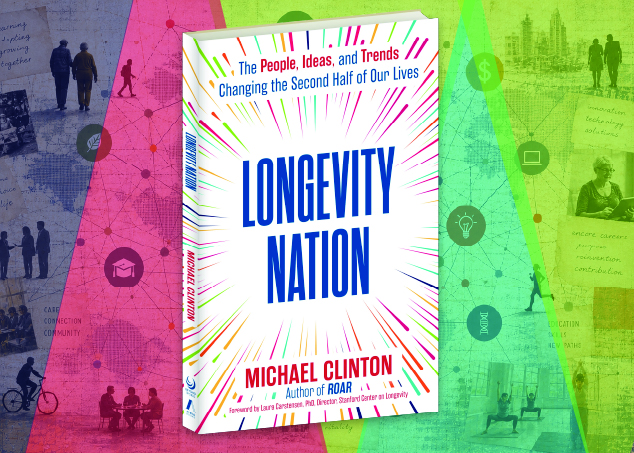 “The word ‘longevity’ is now in the zeitgeist. You see it everywhere,” says Michael Clinton, founder of ROAR Forward, the consulting firm championing people 50+. His buzzy new book, Longevity Nation: The People, Ideas, and Trends Changing the Second Half of Our Lives, is the May selection of the Next Big Idea Book Club. In it, Clinton writes about the ways that fields from medicine to media and technology to travel are evolving as people live longer.
A member of the Stanford Center on Longevity Advisory Council, Clinton is the former president and publishing director of Hearst Magazines. (In his spare time, Clinton, 72, has run marathons on seven continents, including Antarctica.)
Longevity Nation picks up on the themes of Clinton’s 2021 bestseller, Roar Into the Second Half of Your Life (Before It’s Too Late), which introduced readers to people he calls “re-imagineers,” such as former pilot David Harrison who, shortly before hitting his airline’s mandatory retirement age, got a master’s in wealth management and became a financial adviser to other pilots. “They’re everyday people who are also the innovators in the longevity spectrum,” Clinton says.
This interview has been edited for length and clarity.
One of the questions you ask in the book is: Are we ready for the 100-year life? Are we?
No, simply no. Outside of America, there’s a lot happening to prepare cultures and societies for the 100-year life. Asia is way ahead of us in terms of public policy, business policy, infrastructure and societal institutions. Parts of the EU are next up in addressing this. But I think it is a huge blind spot in the U.S.
Part of it might be that we’ve been an obsessive youth culture, more than many countries. We haven’t addressed longevity from a structural standpoint; we don’t have a federal policy.
You write about many ideas and trends changing the second half of our lives. Are there one or two that most excite you?
The intersection of medicine and technology, and we’re at the cusp. The emergence of what many think the GLP-1 drugs will be with a longevity byproduct is revolutionary. And there’s a whole new class of drugs emerging to slow the process of Alzheimer’s. I think the development of precision medicine driven by AI, with personal longevity assistants manifested by wearables, is still in early stages. In 5 or 10 years, we’re all going to be wearing some form of wearable that will drive longevity.
How well are workplaces reimagining themselves for longer lifespans?
Some of the financial services companies are doing a good job. In media and advertising, we’re seeing some progress. Where there is still a blind spot is on the marketing-media targeting side. There’s still this lack of acknowledgement that people over 50 are vibrantly dynamic on social media. They’re on TikTok, they’re on Facebook, they’re on Instagram, but they don’t get targeted through those channels. There’s such a huge opportunity. The 50+ market does $8 trillion of spending, which would be the third largest GDP in the world. But in the traditional media matrix, you stop targeting people at 55. There’s a lot of 20th-century thinking that still exists in a 21st-century world.
You write that in the first half of our lives, our identities are often trapped in the three Ps: finding a life partner, becoming a parent if that’s your choice and starting a profession or paying job to pay the bills. But you say they tend to evolve as we reach midlife. How?
We all know the story of the 55-year-old who has been reorg’ed out of their company for whatever reason, whose kids are gone and who is now an empty nester. So the idea is that as the three Ps diminish, you need to get to the next level of identifying who are you? You can do it through engaging in a passion project or picking up something new that you’ve been interested in and start cultivating it. I say to people, “You don’t have to go get a degree, but you’ve got to do something.”
You’re a fan of what you call life layering and started doing it when you were 39. What is life layering, and why do you like it so much?
Life layering is the practical application of identifying what excites you and adding layers of richness and experience to your life. I was always interested in becoming a pilot, so I started taking flying lessons when I was 40-ish. It led to me becoming a pilot, but also sparked this adventure thing in my genes, which is part of my life layering.
After all your research into longevity, are you concerned about what Dr. Ezekiel Emanuel calls the “wellness industrial complex”?
Well, there will always be suspect players, right? Somebody who’s trying to sell you some promise that has no backing or science.
I think the bigger issue is how do we take longevity products from being elite offerings down to the general population? That’s the holy grail. I’m optimistic that we’ll get there because there’s a huge, commercial, profitable business to serve those people.
KEEP READING
FIVE QUESTIONS
Michael Clinton on “Life Layering”
ALT/SHIFT
She’s 88. He’s 21. They’re Classmates
FINANCING LONGER LIVES
How to Balance Love and Money Decisions
DEEP DIVE
Betting on the Longevity Market
How Leading Brands Are Winning the 50+ Economy
GRANDPEOPLE
Meet the King of Big Veg
GAME CHANGER
Incarcerated as a Teen, He’s Now a CEO
LONGEVITY LITERACY
The Longevity Dividend
@SCL:
2026 Design Challenge Winners
Chip Conley on “Transitional Intelligence”
SCL on the Air
Readers of SCL Magazine will receive a 20 percent discount by ordering Longevity Nation from Beyond Words. Enter the promo code: LONGEVITY20 (valid only on publisher’s website).
Richard Eisenberg is an “unretired” journalist and podcaster specializing in longevity, work, money and retirement. He writes “The View From Unretirement” column for MarketWatch.
RELATED ARTICLES

Dr. Ezekiel Emanuel Says Ignore the “Wellness Industrial Complex”

From Sprint to Marathon: Mapping Four Quarters of the 100-Year Life