
DEEP DIVE
The Robots are Coming (Don’t Panic)
By Laura M. Holson
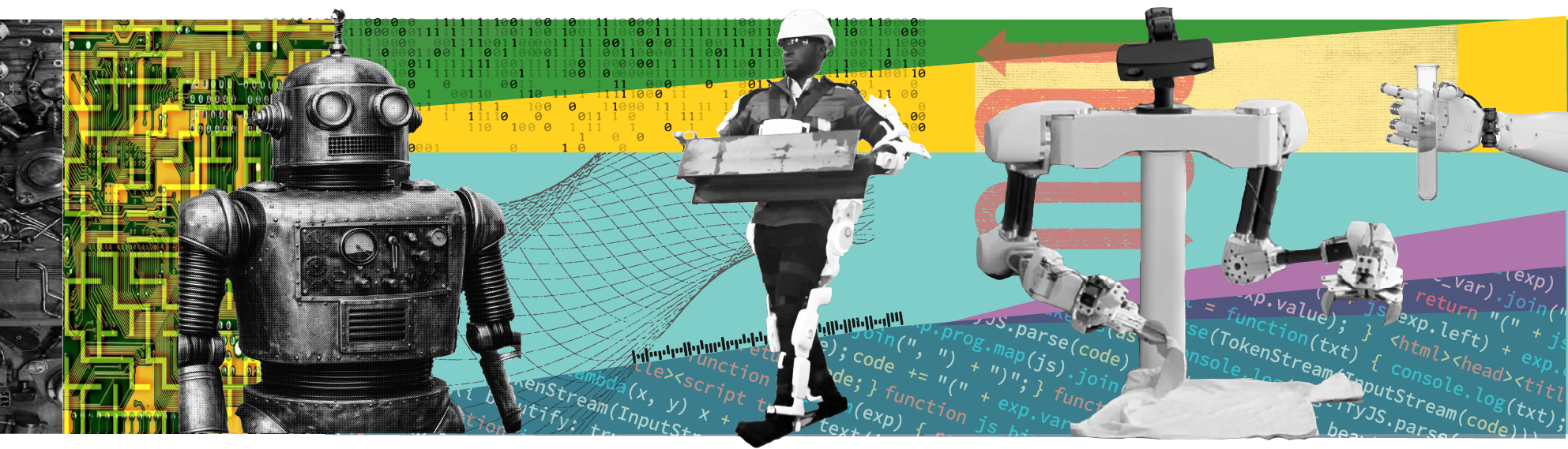
Stanford researchers are developing technologies — from milli-bots that clear blood vessels to droids that tidy homes — which promise extended healthspan, greater independence and dignity for people as they age.
Last June, researchers at Stanford Engineering announced the development of a tiny robot whose unique spinning motion could change the way strokes are treated. The magnetic milli-spinner, barely the size of a small grain of rice, is inserted into the bloodstream to break up fibrin networks that trap red blood cells and form life-threatening clots. Someone has a stroke every 40 seconds in the U.S., making it a leading cause of death, according to the CDC. And nearly three-quarters of all strokes happen in people over the age of 65.
Because the milli-spinner is untethered and magnetically controlled, researchers say it is more than twice as effective as current remedies and can be deployed quickly to save lives. And while it may be years before this diminutive lifesaver is available for clinical use, it points to a future once conjured up in 1960s science fiction fantasy movies and television shows, like The Outer Limits, where microbots perform unimaginable tasks inside the human body.
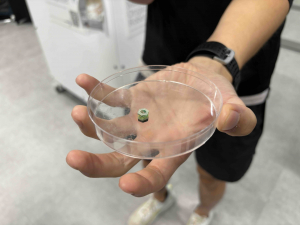
Magnetic milli-spinner for robotic endovascular surgery fits in a researcher’s hand
In the basement of Stanford’s Electrical Engineering building, named for personal computing pioneer David Packard, cofounder of Hewlett-Packard, the Stanford Robotics Center has become a hub for three dozen researchers developing technologies, like the milli-spinner, that promise to be equally life-changing for the 21st century. They come from a range of disciplines — bioengineering, computer science and medicine — and many of them are reshaping the future of aging. Everything from space-age walking buddies to Jetsons-era butlers that pack suitcases, point to a future that diverges sharply from the reality many older adults experience today. Even more so for baby boomers, given that the number of people in the U.S. in their 80s and 90s is expected to more than double to an estimated 17.5 million households by 2038, up from 8.1 million in 2018, according to a Harvard University study.
As the Center on Longevity’s New Map of Life notes: “Today’s 5-year-olds will benefit from an astonishing array of medical advances and emerging technologies that will make their experience of aging far different from that of today’s older adults.”
At the Robotics Center, a dance studio pulses with neon-green light and is equipped with motion-capture technology to record dancers’ movements — data that will be used to teach robots how to safely navigate among people. In another room, researchers are trying out an anime-inspired companion robot with an orange body, expressive face and oversized fingers that is made by the French company Enchanted Tools. There, too, researchers are experimenting with a domestic robot that can pack luggage or make a bed. The goal of the Center is not to replace humans, but to aid human and robot interactions, making it easier for people to stay physically active, remain independent and reduce the cost of elder care. “I don’t think the robot becomes the sole caregiver,” says Steve Cousins, the center’s executive director. “But if, for example, somebody’s got Alzheimer’s and is wandering around, it takes a huge load off of the spouse if they can say, ‘Robot, watch Mike right now and just make sure that he’s okay.’”
“It takes a huge load off of the spouse if they can say, ‘Robot, watch Mike right now and just make sure that he’s okay.’”
“Wellness” Droids for Toting, Tidying — and Companionship
Mobility is a cornerstone of longevity robotics as activities like walking reduce the severity of cardiovascular disease, type-2 diabetes and cognitive decline. In 2022, researchers at the Stanford Biomechatronics Laboratory introduced a prototype for a portable exoskeleton, which resembled a wired calf-to-ankle boot, that can adapt to a person’s gait. This was notable because the exoskeleton had real world capabilities and made it easy to walk using less energy. Researchers are now experimenting with a companion droid they hope will encourage healthy habits. “We got really interested in how robots might be able to help with what we could call ‘wellness robotics,’” says Michelle Baldonado, a research engineer at the center, who is focused on robotics for older adults.
That means everything from companions to combat loneliness to robots that nudge you to take a hike. The gitamini droid is a sleek, wheeled bucket with wheels that carries books and groceries, and is designed to follow its human companion around, “intuitively and politely,” according to Piaggio Fast Forward, the droid’s Boston-based manufacturer. The gita uses cameras for tracking, much like R2-D2 in the movie Star Wars. (For kicks you can buy a Star Wars–branded gita droid online for $2,875.) Baldonado says Piaggio gave Stanford access to its technology, allowing researchers to modify the gitamini by adding a computer screen with Chat GTP that is attached to a rod on the droid’s body. Baldonado named it Rosie, after her mom, to simulate a talking friend. “What’s your name?” it chirped as it rolled up to me. “Nice to meet you.”
I told Rosie I wanted to walk to the center of campus and she cheerily suggested a route, describing points of interest along the way. It was like listening to travel guru Rick Steves in overdrive, as it parsed the architectural significance of each building and suggested a coffee shop to visit. The compartment for cargo made it practical, and the idea of a city of singletons talking to their robots instead of staring blankly at their cellphones sparked a certain curiosity.
But Baldonado says they wanted the droid to do much more. So, they hired Jing Liang, a postdoctoral researcher and a fellow in SCL’s New Map of Life program, to configure the droid’s navigation so it would not only follow, but lead people too. Liang says he plans to program the droid to give warnings about curbs and sidewalk cracks, suggest alternate routes and advise walkers to rest if their balance looks unsteady or wobbly. “The robots will observe human behavior,” Liang says, adding that the team plans to have a prototype in a year or so.
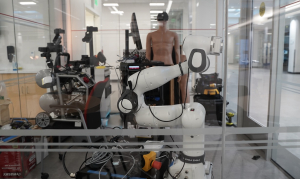
Inside a research bay at the Stanford Robotics Center
Research, too, is focused on the home. The TidyBot is a domestic robot with a motorized arm and grippers for hands that operates using computer vision and artificial intelligence. It identifies everyday objects, like plates and laundry, which it picks up and places in drawers, on counters, even drops in a basket. As importantly, the robot can be personalized to meet individual needs. The Interactive Perception and Robot Learning Lab at Stanford was a key contributor to this futuristic Marie Kondo, which researchers say organized 85 percent of the items it encountered in real-world tests.
“We’re looking for the good ideas, and then encouraging researchers to run with them.”
Cousins says Stanford doesn’t manufacture products to sell. But several projects, like ToddlerBot, share their work with the wider community via open-source robotic platforms and code. It can take years to create a prototype, and that’s before the challenge of getting an innovation manufactured and to market. Still, Cousins says the demand for robots designed for healthcare and home use is promising given the aging population. “As soon as you start talking about caregiving and longevity, the whole economic equation changes,” he says. A domestic robot that costs $10,000, or even $100,000, might make sense when you consider that a nursing home can cost $8,000 or $10,000 a month, he says. “It’s super easy to justify a very sophisticated robot, in that case.”
In October, Cousins and Baldonado attended the RoboBusiness conference and expo in Santa Clara, California. “I’ve been impressed at how many are interested in the space right now,” Baldonado says. There, they found a device that could lift up a person from the front (a delicate proposition, at best) and place them on a bed or toilet. The user controls the device with a joystick. “They spent a lot of time on the design so that it was actually comfortable,” Baldonado says. She and Cousins were so impressed, they talked to the maker about how Stanford students might work with them.
Recently, they met with Izumi Yaskawa, the executive director of Live Oak Adult Day Services, a Bay Area–based daycare that provides socialization and cognitive stimulation for older adults with physical or cognitive impairments. Isolation, Yaskawa says, is one of the greatest challenges for older adults. A review of scientific studies conducted between 1996 and 2022 showed that people who experienced social isolation and loneliness had a higher risk of cardiovascular disease and stroke. “As your social circle gets smaller, you kind of feel that your world is diminishing,” she says. “It’s the theory of use it or lose it.”
Indeed, cognitive decline is a global issue. In Japan, where cases of dementia are soaring, government agencies and concerned family members are adopting GPS-based systems to keep track of those who go missing, according to a recent BBC report. Other technologies aim to detect dementia earlier, for instance, by using artificial intelligence to analyze posture and walking patterns.
Yaskawa, who previously cofounded a company with Cousins, says two issues intensify a lack of sociability among older adults: incontinence and mobility. “You kind of start retreating from outdoor activities because of incontinence,” Yaskawa says. At a brainstorming meeting with Baldonado and Cousins, Yaskawa shared her observation. Someone came up with the idea for a companion robot that was equipped with a porta-potty system. “It’s grounded in trying to solve the problem of getting people to walk more,” says Cousins, although the center is not pursuing it.
Still, the discussion opened the door for Baldonado and Cousins to observe how older adults, as well as caregivers, could benefit in this burgeoning era of robot and human interaction. One idea that has gotten some interest, and which was inspired by a visit to Live Oak, is a hands-free robotic device that is not a walker, but would give older adults the ability to stand and move around without the fear of falling. “It just opens up a great way for us to think about what’s possible,” says Cousins. “We’re looking for the good ideas, and then encouraging researchers to run with them.”
KEEP READING
GAME CHANGER
The Librarian With a Business Plan for Well-Being
ALT/SHIFT
Does Your Financial Plan Cover These Risks?
DEEP DIVE
The Robots Are Coming (Don’t Panic)
GRANDPEOPLE
Bobbing Bubbe
FROM THE EDITOR
LONGEVITY LITERACY
Cumulative Social Advantage
FIVE QUESTIONS
Galit Nimrod on the World’s Largest Retirement Community
@SCL:
Century Summit
Fellow Profile: Mike Kinney
SCL in the News: The Best Years of Your Life Are Probably Still Ahead

