
ALT/SHIFT
Does Your Financial Plan Cover These Risks?
By MP Dunleavey
Preparing for the long term starts with money, but it also should include vital quality-of-life factors.
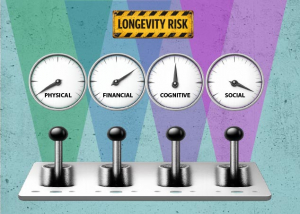 For decades, the cornerstone of financial planning was helping retirees avoid the perils of running out of money, a problem known as longevity risk. Now, with people living into their 80s, 90s and beyond, there’s a growing push to expand the scope of risk management — and help people avoid equally steep losses in terms of quality of life.
It’s a remarkable shift in a field not known for bold moves. In a recent white paper, From Longevity Literacy to Longevity Fitness, Surya Kolluri, head of the TIAA Institute*, calls out three other risk factors that he and others believe call for intervention on par with financial mismanagement: cognitive decline, physical frailty and social isolation.
By focusing on quality-of-life as well as financial risk factors, Kolluri believes people can achieve longevity fitness. “Let’s say somebody gets to age 100: You want them to get to age 100 and be fit,” he says. “And what are all the dimensions of fitness? We want to match lifespan with healthspan, and we also want to match lifespan with wealthspan.”
Rethinking Risk Management
The task for retirees and pre-retirees is to understand how these factors connect and how building resilience in one area supports strengths in another. Here are a few places to focus:
Plan for financial longevity.
Traditionally, financial planning was geared toward helping people save enough to retire. Now, for those who have been able to save sufficient resources, the challenge lies in helping people allocate their money over the course of much longer lives. “Many retirees need help understanding how they can turn their assets into a reliable income stream,” says Jeff Clark, director of defined contribution research with Vanguard and coauthor of How America Retires.
This is trickier than it sounds, in part because most people underestimate how long they’re likely to live, according to Gal Wettstein, associate director of health and insurance at the Center for Retirement Research. “As a consequence, they may not prepare adequately,” he says, by protecting their income via annuities or long-term care insurance.
A better understanding of longevity might inspire people to explore new options in income planning. A growing number of financial companies now offer a hybrid investment that combines a target-date fund with annuity features — i.e., a portfolio that adjusts its allocation over time and can provide a paycheck of sorts in retirement.
Manage cognitive risks.
The rule for managing most risks is: Act sooner rather than later. This is especially true for cognitive health, where financial skills may founder long before the doctor diagnoses memory problems, this study found. “As retirees age, their ability to manage complex financial decisions may diminish,” Clark notes. “It certainly increases that vulnerability to make mistakes — and it presents opportunities for fraud.”
Fortunately, on the financial front there are a host of protective steps people can take, from setting up powers of attorney to identifying trusted individuals as deputies for key decisions. More broadly, though, each person’s brain health will depend on building up cognitive reserves, Kolluri says, so their minds can function better, longer.
As a robust body of research shows, making steady deposits over time to enrich your cognitive reserve fund can be accomplished in numerous ways: maintaining your cardiovascular health and sensory perception, for instance by getting a hearing aid, which in turn supports staying connected. “One essential driver of cognitive reserves is socialization — being with other people,” Kolluri adds. This speaks to the core idea of the longevity fitness model, that investing in one dimension has reciprocal gains in another.
“Making steady deposits over time to enrich your cognitive reserve fund can be accomplished in numerous ways.”
Invest in physical stamina.
The association between growing old and becoming sick or frail (or both) is a hard one to break. Yet cultivating physical strength and stamina can increase resilience and stave off decline, according to the National Institutes of Health.
One of the most effective ways to manage the risk of physical deterioration is to prevent falls, Kolluri says. “Nine out of ten injuries in people over 65 come from falls — and we generally don’t think about it until it happens,” Kolluri says. “But the moment it happens, it’s a vicious spiral downward.”
Lack of mobility leads to physical decline in some cases, and social isolation in others — which can contribute to cognitive losses, financial strain, and more. Again, there are numerous factors that influence each person’s physical condition. But employing a risk-management mindset in a crucial area such as fall prevention could yield protective benefits.
Nourish social networks.
According to the Harvard Study of Adult Development, an exploration started in 1938 of what makes for a happy, healthy life, the most powerful factor in our well-being is the quality of our relationships.
Yet loneliness is so widespread that in 2023 former U.S. Surgeon General Vivek Murthy declared a national epidemic of isolation. In 2018, the British government even named a Minister for Loneliness to address the profound social and health effects. Studies have linked chronic loneliness to higher risks of heart disease, depression, weakened immune function, and even dementia.
In short, nourishing social networks may appear last on this list, but in the hierarchy of risk factors to manage, this one comes first in many ways — because the gains from strong social ties accrue to all the other dimensions.
“The gains from strong social ties accrue to all the other dimensions.”
Where to start? These choices are highly personal, but Kolluri suggests adapting a relationship version of “catch-up contributions,” a retirement account rule that allows people to save an extra amount starting at age 50. In a similar way, Kolluri says, people could invest a little extra in their social circle by seeking out old friends and making new ones. And rather than focusing on digital platforms, he says, look up people you know while you’re on vacation or on a business trip and reconnect with them in real life.
This new paradigm offers an intriguing new take on risk management that’s both financial and qualitative. Taken together, this multidimensional approach could truly deliver better-than-average returns as we age.
*TIAA is a member of the Stanford Center on Longevity’s Corporate Affiliates Program.
KEEP READING
GAME CHANGER
The Librarian With a Business Plan for Well-Being
ALT/SHIFT
Does Your Financial Plan Cover These Risks?
DEEP DIVE
The Robots Are Coming (Don’t Panic)
GRANDPEOPLE
Bobbing Bubbe
FROM THE EDITOR
LONGEVITY LITERACY
Cumulative Social Advantage
FIVE QUESTIONS
Galit Nimrod on the World’s Largest Retirement Community
@SCL:
Century Summit
Fellow Profile: Mike Kinney
SCL in the News: The Best Years of Your Life Are Probably Still Ahead
