FIVE QUESTIONS
Allison Pugh on the Bonds That Sustain Us
By Richard Eisenberg
Relationships can’t be automated, says the author of The Last Human Job.
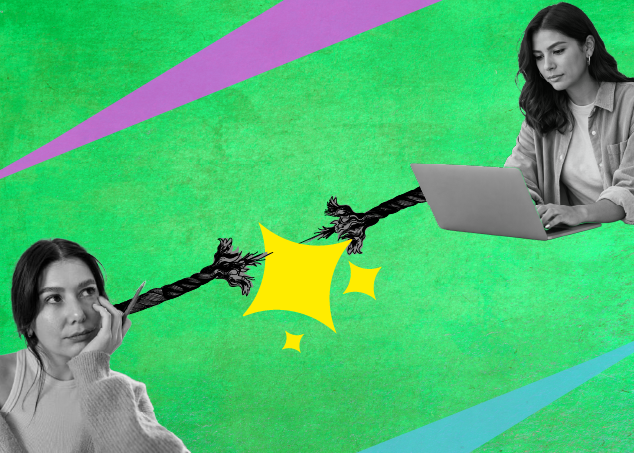 For her book, The Last Human Job: The Work of Connecting in a Disconnected World, Johns Hopkins University sociology professor Allison Pugh traversed the country talking with and observing more than 100 workers, including therapists and teachers, physicians and chaplains, whose work requires intense interpersonal contact. She came away alarmed. Pugh, a former journalist, found that the “connective labor” central to the professions she studied — and to millions of jobs — is disintegrating under pressure from automation and employers’ drive for efficiency.
Connective labor, Pugh told me, is the interactive practice of “seeing the other and having the other feel seen.” She noted that although a person’s skill can be performed by artificial intelligence, “what can’t be automated is the relationship between two human beings.” At the Stanford Center on Longevity’s recent Century Summit on longevity, learning and the future of work, Pugh said AI is increasingly functioning to automate connected labor for workers and, in the process, can sometimes “deter human connection.”
This interview has been edited for length and clarity.
What are the effects of AI and automation on connective labor?
It’s eerie how vulnerable we are to this kind of automation. We trust machines. We think AI is going to have our best interests at heart and isn’t going to judge us. We feel seen. We feel heard. And yet AI is produced by profit-making companies that want you to be engaged and to stay on for hours. I wrote the book to try and convince people to get up in arms about this. We face three futures, and we get to choose among those futures. None of them are good, I’m sorry to say.
One is the triage model, where machines do the easy customer service cases, and as things get more complicated they get bumped up to the human being. That’s what you see now when making an airline reservation. You go to an agent often only if you scream “Agent! Agent!” into the phone. Then the machine will send you to the agent.
Another future is also very present, which is an inequality model where low-income people get the bot and wealthy people get the person. That’s human contact as a luxury, and it feels really insidious to me.
The third future is the most palatable perhaps, but has its own problems. That’s the binary model where machines are doing the thinking and humans are doing the feeling. I did observations in a Silicon Valley school where most of the adults were “content specialists” or “advisers.” The content specialists taught brief, small-group lessons on a particular concept. Advisers were feelers who sat with their computers open and met with kids one-on-one once a week. I could see the future in a less well-resourced school where they would save money by having just professional feelers.
What was the most important thing you learned from your interviews about how people understand connective labor?
That the process of imposing systems to script or manualize connection really degrades the work and leads to its automation. It’s not like people are wandering around going, “Let’s automate that nice relationship you have with your therapist.” They’re taking connections that are not going that well and saying, “Well, we might as well automate it.”
What are the implications for multigenerational workforces using connective labor?
Connective labor is really important for managers; it’s how employees get motivated. I think multigenerational workforces probably are challenging in that regard because you’re working with somebody who maybe you don’t relate to. But to the extent that you’re able to do so, it has a powerful, unifying outcome. It helps people feel like they belong.
When I looked at organizations trying to deliver connective labor, one of the dimensions that seemed to matter most reflects mentoring. I remember observing a physician mentoring a med student and seeing him give her little tests but also acknowledging her doing well and giving her a chance to do it herself. I think mentoring is a gift, and one we don’t often teach.
Many people as they get older turn to gig work and platforms. Do organizations that offer this type of work value connective labor?
Not very much. There’s one pernicious type of gig work for nurses described in a study by the Roosevelt Institute, where nurses outbid each other [in on-demand nursing platforms] to see how low they can go [in wages] to get an assignment and are penalized if they stay longer than their shift to pass information about the patient to the person who’s taking over. That means patients are just being dumped.
What could organizations be doing to make connective labor work better for people and not impede the work?
Take it seriously. Pay attention to human attention. Machines are so devastatingly good at what we used to think were human attributes. But I think there’s still something uniquely powerful about a human being seeing you.
Richard Eisenberg is an “unretired” journalist and podcaster specializing in longevity, work, money and retirement. He writes The View From Unretirement column for MarketWatch and is director of Digital Media Strategies at the NYU Summer Publishing Institute.
KEEP READING
FIVE QUESTIONS
Allison Pugh on the Bonds That Sustain Us
ALT/SHIFT
Economic Mobility Is Intergenerational
FINANCING LONGER LIVES
You Need a Financial Longevity Planner
DEEP DIVE
Why the “Good Death” is Having its Moment
GRANDPEOPLE
Raves for DJ in her 60s
GAME CHANGER
Scott Delp: Movement As Medicine
LONGEVITY LITERACY
Fluid v. Crystalized Intelligence
@SCL:
Design Challenge Finals
A Big Data Analysis of Career Gaps
Financial Advice in the Age of Longevity
RELATED ARTICLES
Cumulative Social Advantage
The Librarian With a Business Plan for Well-Being