
FROM THE EDITOR
 April is associated with rebirth, renewal and the resurgence of life. Why, then, are we featuring the “good death” in this issue? It’s a fair question — and the answer goes to the heart of what this magazine is about and to the purpose of the Stanford Center on Longevity over the past 20 years.
“Longevity” has become a buzzword appropriated by influencers and wellness gurus, and in Silicon Valley culture it is often conflated with the fantasy of immortality.
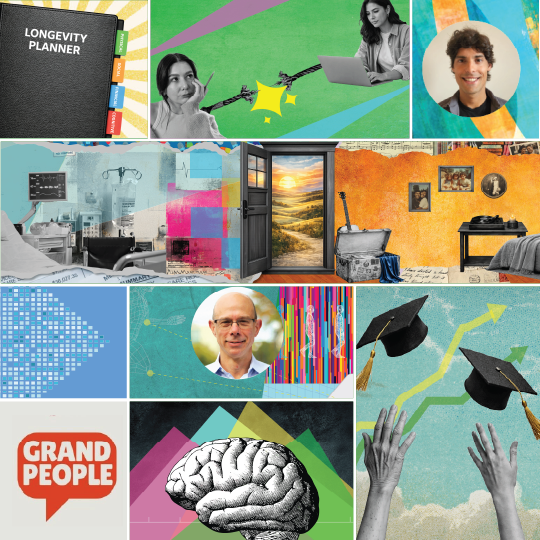
At SCL, we study the human lifespan and the many factors that contribute to — or diminish — people’s ability to live longer, healthier, more socially connected and financially secure lives. Our findings are rooted in science, not fads. And while lifespans are getting longer, the arc does inevitably come to an end. How we arrive and what constitutes a good ending is the subject of this month’s Deep Dive by Laura Holson. From death doulas and death cafés to living funerals and the Medical Aid in Dying movement, her story explores a cultural shift around death and dying and what people want to experience and leave to others at the end.
Those who work with dying patients perform what sociologist Allison Pugh calls “connective labor,” which calls for deep interaction and cannot be automated by AI without losing its human essence. In Five Questions, Richard Eisenberg interviews Pugh about her new book The Last Human Job: The Work of Connecting in a Disconnected World.
Financial planning is another field where the human element is critical, and relationships and connection matter as much as number-crunching. MP Dunleavey’s column on Financing Longer Lives covers the challenges of developing holistic longevity plans that go well beyond portfolio management, a topic explored at a recent SCL convening of financial industry professionals.
As the group discussed, one of the most important longevity risks is cognitive decline, a vital topic that most financial planners feel ill-equipped to raise with clients. It’s a complex area, and new research shows that cognitive abilities evolve throughout adulthood, and not always for the worse. Our Longevity Literacy column delves into new research about intelligence that further supports the idea that there is no single peak of cognitive capability. Instead, as Katherine Healzer reports, “it’s more like a mountain range; there are different peaks at different ages, and each is valuable for different challenges.”
Alt/Shift features Hope Chicago, a four-year-old nonprofit that is sending two generations — a student and a parent or grandparent — to college at the same time, proving that economic mobility can be intergenerational. The organization is one of six visionary winners of the Big Ideas in Higher Education Challenge, cosponsored by SCL and CoGenerate, and focused on transforming campuses into hubs for intergenerational collaboration and lifelong learning.
Our Game Changer is Scott Delp, a professor of bioengineering at Stanford whose recent innovation on human movement can help predict difficulties as people age or deal with sports injuries or falls, preserving mobility affordably and quickly.
On a lighter note, the latest episode of GrandPeople introduces you to DJ “Tina Technotic,” who is on the club circuit from London to Miami, mixing for intergenerational dance parties.
We hope you’ll find plenty in our April issue about the vibrancy and resilience of life to get your spring off to a lively start!
—Karen Breslau
KEEP READING
FIVE QUESTIONS
Allison Pugh on the Bonds That Sustain Us
ALT/SHIFT
Economic Mobility Is Intergenerational
FINANCING LONGER LIVES
You Need a Financial Longevity Planner
DEEP DIVE
Why the “Good Death” is Having its Moment
GRANDPEOPLE
Raves for DJ in her 60s
GAME CHANGER
Scott Delp: Movement As Medicine
LONGEVITY LITERACY
Fluid v. Crystalized Intelligence
@SCL:
Design Challenge Finals
A Big Data Analysis of Career Gaps
Financial Advice in the Age of Longevity