
FIVE QUESTIONS
Galit Nimrod on the World’s Largest Retirement Community
By Richard Eisenberg
Why the Seniorland author says The Villages model “will grow and grow.”
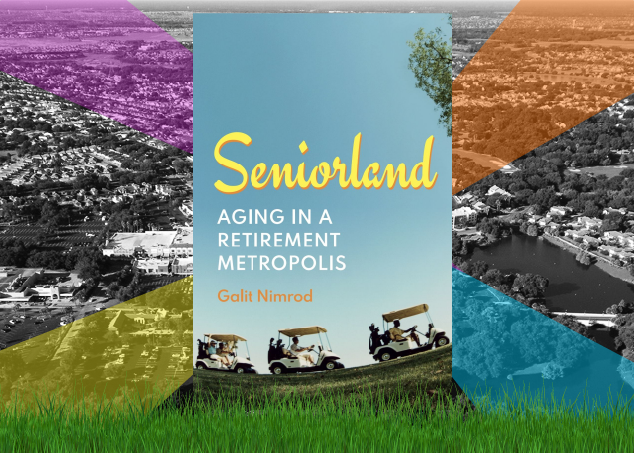
Galit Nimrod, a gerontologist and communication studies professor at Ben-Gurion University of the Negev, is fascinated by how people age, as well as where and why. For her 2022 book, The Aging of Aquarius, she caught up with dozens of 1960s hippies who lived at the Tennessee commune The Farm, or still do. Her new book, Seniorland: Aging in a Retirement Metropolis, offers Nimrod’s insights from spending two months in a very different type of senior community: The Villages in central Florida. Its 150,000-plus residents make The Villages the world’s largest retirement community and one of America’s fastest-growing metro areas.
After interviewing 40 residents of the 55+ leisure-oriented development and participating in an assortment of its thousands of clubs and activities, Nimrod found that the media representation — as well as her own preconceptions — of The Villages were way off. In fact, Nimrod believes The Villages may represent a future version of longevity in America. The development reportedly has plans to keep building new homes for at least the next 20 years.
There have been so many media reports about The Villages, often unflattering. What made you want to write a book about this retirement community?
The past two decades show that retirement communities have grown exponentially. Surprisingly, even though this is such a significant phenomenon, there has not been much academic research relating to the sociological aspect of this growth. If we’re going to see more communities of this kind, I think it’s important to understand the benefits of residing in such places and the disadvantages.
What surprised you the most about The Villages, both in a positive way and a negative way?
I was surprised by the variety of people I met. We know that older adults are very heterogeneous, more than any other age group, and this is reflected in The Villages.
I expected to find only older Republicans talking about Trump, and swinging couples. But in The Villages, you have all sorts of people looking for the good life in retirement. It’s not just that there are so many golf courses, recreation centers and activities, but that people there try new things all the time. Innovation in leisure contributes to well-being by allowing for the opportunity to discover new aspects of the self and even reinventing ourselves.
Demographically, though, people at The Villages are 97% white, which I find disturbing. Most are from middle-class backgrounds, so they can afford being there [single-family homes range in price from the low $200,000s to more than $1 million].
I was surprised how many residents want to keep contributing to society. The rate of people who volunteer at The Villages is unbelievable, organizing and coordinating its leisure activities.
A negative surprise was that I heard quite a lot about political tension. Originally, The Villages was very red; now Democrats make up about one-third of the population. I heard terrible stories about people who had to move to a different part of The Villages because they felt unwelcome by their neighbors. I think this tension is something we see all over the United States; it’s not unique to The Village.
The Village is an age-segregated community, and you wrote that a lack of contact with younger people is a loss to society at large. Why do you say that?
It is a loss to society because if the residents’ needs had been met in the communities where they lived, they could have brought to those communities all the energy and time they dedicate to volunteering in The Villages.
Some people I interviewed said they miss the presence of younger people. But if they go to the city squares, they can interact with younger people. Residents of nearby communities come there for the music and the dancing. So, it’s not like people are completely age-segregated at The Villages.
Another popular retirement community that has received a lot of media attention is Latitude Margaritaville, inspired by Jimmy Buffett. There are two in Florida, one in South Carolina, and more planned for Texas. How is The Villages different from Margaritaville?
I think Margaritaville is mostly about having fun; it’s a themed community, all about Jimmy Buffett and “it’s 5 o’clock somewhere.” So it’s about drinking and all that. Also, Margaritavilles are much smaller than The Villages [roughly 3,000 to 4,000 people live in each Margaritaville].
In what ways is The Villages the future of where and how we’re going to live as we get older?
This is a phenomenon that is going to grow and grow and grow. Every year, The Villages sells 2,000 to 4,000 new units, so I think it’s a model that’s going to continue to thrive.
In the future, we’ll have more and more older people who are healthy and want to enjoy life. So we’re going to see cities like The Villages keep growing, although maybe not as big as this one. Maybe we will see more themed cities — new-age retirement communities, or technology-oriented retirement communities. We may see developers competing to offer unique selling propositions.
KEEP READING
GAME CHANGER
The Librarian With a Business Plan for Well-Being
ALT/SHIFT
Does Your Financial Plan Cover These Risks?
DEEP DIVE
The Robots Are Coming (Don’t Panic)
GRANDPEOPLE
Bobbing Bubbe
FROM THE EDITOR
LONGEVITY LITERACY
Cumulative Social Advantage
FIVE QUESTIONS
Galit Nimrod on the World’s Largest Retirement Community
@SCL:
Century Summit
Fellow Profile: Mike Kinney
SCL in the News: The Best Years of Your Life Are Probably Still Ahead
