• Link to Youtube
  • Link to LinkedIn
Stanford Center on Longevity
  • ABOUT
    • GENERAL
      • About SCL
      • Annual Reports
      • Contact
    • PEOPLE
      • Leadership, Scholars & Staff
      • New Map of Life Impact Fellows
      • Faculty Affiliates
      • Advisory Council
      • SCL Ambassadors
    • AFFILIATED CENTERS
      • Stanford Distinguished Careers Institute
      • Glenn Foundation for Medical Research
      • Stanford Lifestyle Medicine
  • RESEARCH & INNOVATION
    • The New Map of Life Initiative
    • Postdoctoral Fellows Program
    • The Futures Project on Education and Learning for Longer Lives
    • The Sightlines Project
    • Longevity Design Challenge
    • Publications
  • MEDIA & EVENTS
    • SCL Magazine
    • Longevity Book Club
    • Century Summit
    • Century Lives Podcast
    • SCL in the News
    • Videos
  • ENGAGEMENT OPPORTUNITIES
    • Press inquiries
    • Postdoctoral Fellowship application
    • Industrial Affiliates Program
    • Stanford Courses
    • Make a gift
  • Click to open the search input field Click to open the search input field Search
  • Menu Menu

Exposed to Scams: What Separates Victims from Non-victims?

By Marti DeLiema, Ph.D., Stanford Center on Longevity,
Emma Fletcher, Federal Trade Commission,
Christine N. Kieffer, FINRA Foundation,
Gary R. Mottola, Ph.D., FINRA Foundation,
Rubens Pessanha, Ed.D., MBA, PMP, GPHR, SPHR, SHRM-SCP, International Association of Better Business Bureaus, Inc.,
and Melissa “Mel” Trumpower, BBB Institute for Marketplace Trust
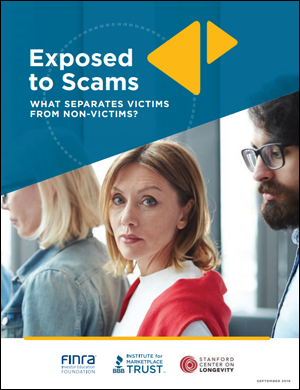
Victimization by scams and fraud depends, in part, on two-way engagement between the target of the scam and the fraudster. Some individuals simply do not engage with a scammer; others engage but at some point recognize the deception and cease engagement. Still others engage with the fraud and lose money (sometimes a lot of money). Despite the enormous personal and financial costs of fraud victimization, little is understood about the factors that differentiate these three groups.

Read the article


© Copyright - Stanford Center on Longevity
  • Link to Youtube
  • Link to LinkedIn
Link to: A strong grip? Push-ups? What actually can help you live to a ripe old age? – <em>The Washington Post</em> Link to: A strong grip? Push-ups? What actually can help you live to a ripe old age? – <em>The Washington Post</em> A strong grip? Push-ups? What actually can help you live to a ripe old age?... Link to: Being happier will help you live longer, so learn how to be happier – <em>CNN</em> Link to: Being happier will help you live longer, so learn how to be happier – <em>CNN</em> Being happier will help you live longer, so learn how to be happier –...
Scroll to top Scroll to top Scroll to top