
RECOMMENDED READING
HOW TO LIVE FOREVER: THE ENDURING POWER OF CONNECTING THE GENERATIONS
By Marc Freedman
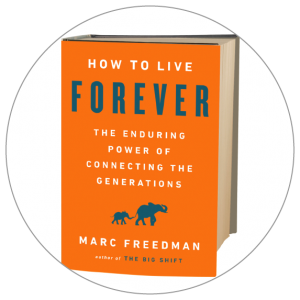
Longtime friend of the Stanford Center on Longevity and intergenerational expert Marc Freedman has written a fascinating and timely new book called How to Live Forever: The Enduring Power of Connecting the Generations. He draws on his former work with Experience Corps and current work at Encore.org (where he is the president and CEO) to describe why, and how, older Americans should invest in, and connect with, the next generation. Despite coming out of Silicon Valley, this is not a book about life extension through genetics or death avoidance, but rather an understanding that real happiness begins with investing in and connecting with younger generations.
Since the dawn of time we have been looking for the foundation of youth, and Marc says he has found it: it is connecting the young and the old in meaningful, purposeful ways. He goes through the vast amount of research on purpose and meaning, on generativity and relationships, and shows how it is intergenerational interactions make us healthier, happier and longer-lived. (For more on this research, see the paper we co-wrote with Marc).
He describes the innovation that is needed to make this idea of connecting the generations for mutual good can come from three basic types of groups: “inventors who are dreaming up radical new ideas; integrators who are bringing existing institutions, like senior centers and preschools, together; and infiltrators who are typically injecting older or younger people into settings where you might not have found them previously.”
His advice on how to get started? 1. Intentionally set up your life (where you live, work, volunteer, worships, etc.) with meaning and purpose in mind. 2. Be a good listener (i.e. be interested, not just interesting). And 3. Sign up and get more ideas from Gen2Gen!
 This article was recommended by Amy Yotopoulos, Senior Research Scholar and Director of the Mind Division at the Stanford Center on Longevity.

